

Jacob had bargained for his brother Esau’s birthright and then deceived his father to obtain the covenant blessing. The plan that his mother, Rebekah, hatched for him to receive the blessing had worked, but it came at a big cost. Esau was furious with his brother and planned to kill him once their father, Isaac, was dead. Jacob had to leave his home and seek refuge with Rebekah’s brother. On his way there, he saw a vision of stairs leading to heaven. In this dream, he saw what we call Jacob’s Ladder.
Sending Jacob to his mother’s family was more than just a cover story to protect him from Esau. Isaac and Rebekah wanted to make sure that Jacob did not marry a Canaanite woman. The fact that Esau had married Hittite women made life bitter for his parents (Gen 26:34-35).
Then Rebekah said to Isaac, “I loathe my life because of the Hittite women. If Jacob marries one of the Hittite women like these, one of the women of the land, what good will my life be to me?” (Gen. 27:46 ESV)
So, Jacob was sent away to Rebekah’s family to find a wife (Gen 28:1). Something very strange, interesting, and special happened to him on his way to Paddan-aram.
Jacob’s Ladder
Jacob stopped for the night at a place about twelve miles north of Jerusalem. As he slept, “he dreamed, and behold, there was a ladder set up on the earth, and the top of it reached to heaven. And behold, the angels of God were ascending and descending on it!” (Gen. 28:12 ESV).
The word which the ESV translates as ladder is a word which can also mean a stairway or flight of steps.1 In fact, the NIV, CSB, and NET Bibles all use the word stairway instead of ladder. It is remarkable that this vision of stairs, traversed by heavenly beings, was a religious motif belonging to Mesopotamia – the very land he was traveling to. Mesopotamia was the home of what we would call stepped pyramids, but what the Mesopotamians called ziggurats.
Ancient Mesopotamian literature tells us that the purpose of the ziggurats was to provide the gods a stairway that led from the heavens down to the god’s temple at the base of the ziggurat. It was not so that people could climb to heaven, but so that the gods could come down from heaven. “Jacob is not seeing a ziggurat, but he is seeing the stairway portal between heaven and earth that ziggurats were designed to provide.” 2
Where did the vision of Jacob’s Ladder happen?
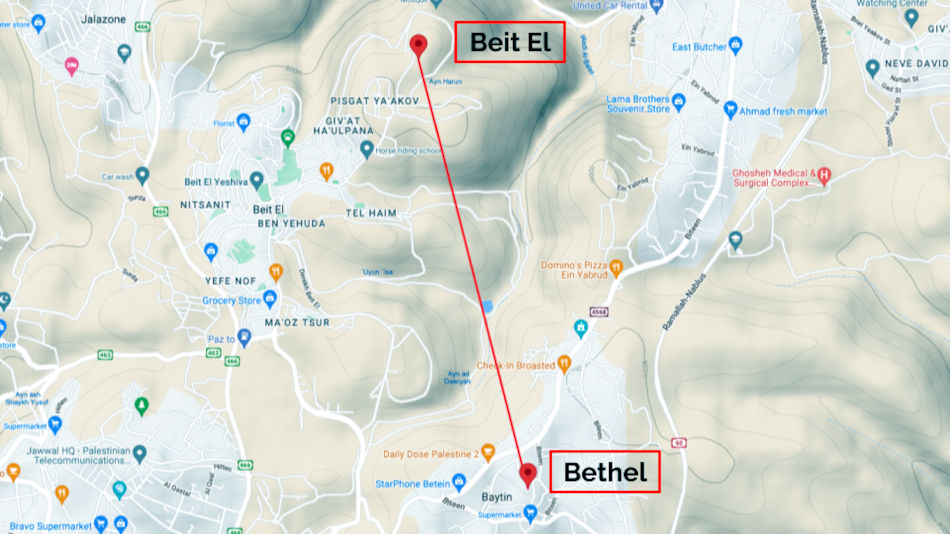
We do not know the precise location where Jacob slept that night, but we do know the immediate area. “He called the name of that place Bethel, but the name of the city was Luz at the first” (Gen. 28:19 ESV). The modern city of Beitin (Baytin) has long been cited as the biblical city of Bethel. There is sufficient archaeological evidence to associate Tell Beitin (which lies within the modern city) with ancient Bethel.3 Regardless of the precise location of where Jacob laid his head, the terrain in the area is noteworthy.
Beit El, traditional place of the dream of Jacob’s Ladder
There is a tradition among the Jews that Jacob’s vision occurred about one mile and a half north of Tell Beitin on a hilltop called Beit El.4
Of course, there is no archaeological evidence that Beit El is where Jacob slept that night. A man who only spends one night in a place leaves no artifacts. Regardless, It is remarkable that the hillsides in this vicinity are naturally terraced and strongly resemble stairs! John Peters, who inspected these “steps” in person, made these remarks:
“One of the most singular stone formations west of the Jordan in Palestine is to be seen in the great stonefield a little to the north of the modern town of Beitin, the ancient Bethel.… Huge stones seem to be piled one upon another to make columns nine or ten feet or more in height. In reality these columns are produced by erosion, and the different density of the strata has led to greater erosion in one part than in another, so that they taper and bulge in manifold and various shapes.”5

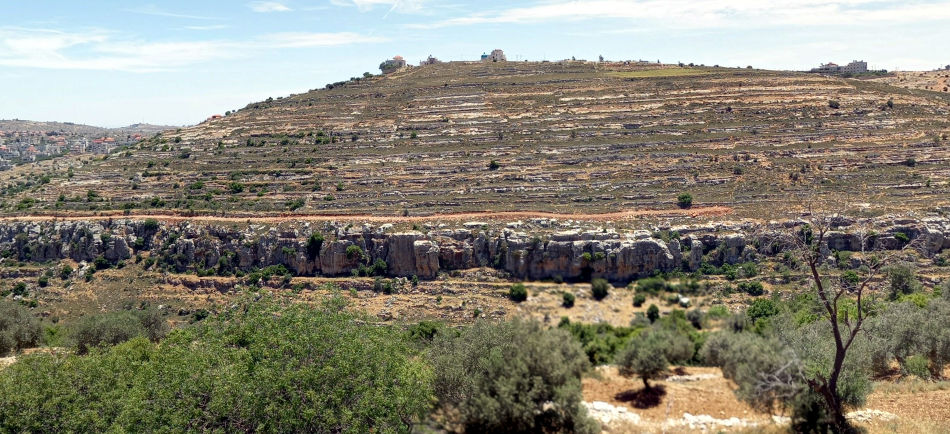
The stairway Jacob saw in his dream was not only a religious concept in Mesopotamia, the land of his ancestors, but also a geographical feature of the place where he slept. The hillsides at Beit El, and in the general vicinity of Bethel, are stepped. Just a coincidence? Perhaps, but I bet when the sun rose the next morning Jacob couldn’t quite look at the hillsides the same way he did the day before.
God confirmed his covenant with Jacob
It was in the vision of “Jacob’s Ladder” that God confirmed His covenant with Jacob. This confirmation amounted to a renewal of the covenant God made with Jacob’s grandfather Abraham. God promised Jacob that his descendants would be numerous, that He would give them the land of Canaan, and that all the nations of the Earth would be blessed through Jacob’s offspring (Gen 28:13-15).
Surely the vision of angels ascending and descending the stairway represented God’s agents carrying out His will in the world on Jacob’s behalf. These heavenly beings were busy with work which would ensure that God’s promise to Jacob would come to pass.
References
- Harris, W. Hall, eds. The NET Bible Notes. 2nd ed. Nashville: Thomas Nelson, 2019.
- Walton, John H., ed. Genesis, Exodus, Leviticus, Numbers, Deuteronomy, Zondervan Illustrated Bible Backgrounds Commentary. Grand Rapids, Mich: Zondervan, 2009. 106.
- Kramer, Joel P. Where God Came Down: The Archaeological Evidence. The Bible and archaeology speak series book 1. Brigham City, Utah: Expedition Bible, 2020. 47-48.
- https://biblewalks.com/beitel
- Peters, John Punnett. Early Hebrew Story: Its Historical Background. G.P. Putnam, 1904, pp. 110–111.