
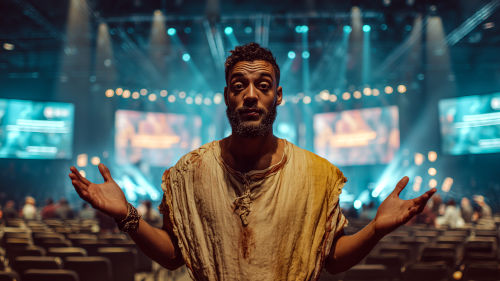
Have you ever wondered if the church you attend would be recognizable to a first century Christian? We read the same Bible they wrote, follow the same Jesus, and use words like ‘fellowship’ and ‘communion’ that come straight from their world, but if a first-century Christian somehow walked into one of our Sunday morning assemblies, would they have any idea what was happening?
The gap between the church we read about in the New Testament and the one we experience today is staggering. Not just in the obvious ways like technology and buildings, but in fundamental practices that shaped how early Christians understood salvation, community, leadership, and what it meant to follow Jesus. Let’s look at a few of the differences.
1. Church Size and Meeting Style
First-century churches met in homes with perhaps 20-50 people maximum (Acts 2:46; Rom 16:3-5, 23; Col 4:15; Phlm 1:1-2) Church meetings were participatory: “when you come together, each of you has a hymn, or a word of instruction, a revelation, a tongue or an interpretation” (1 Cor 14:26).
Modern churches often have hundreds or thousands of members in auditorium-style buildings with professional production, stage lighting, and concert-level sound systems. A few people perform while everyone else sits and listens; sermons are lecture format – foreign to first century house church gatherings.
2. Baptism: Mode and Meaning
First-century baptism was by immersion (the Greek “baptizo” means to immerse/plunge),1 performed immediately upon belief: every conversion in the book of Acts shows that all were baptized the same day they believed.2 It is a historical fact that for the first 1500 years of church history, Christians believed that baptism is essential to receive forgiveness of sins. “Repent and be baptized, every one of you, in the name of Jesus Christ for the forgiveness of your sins” (Acts 2:38).
Many modern churches practice infant baptism by sprinkling and view baptism as a symbolic act unrelated to salvation. Even those who practice believer’s baptism often delay it for weeks or months since they don’t see it part of one’s response to the gospel.
3. Leadership Structure
First-century churches had a plurality of elders (presbyters) leading each congregation; Paul appointed “elders” (plural) in every church (Acts 14:23, 20:17, 28; Phil 1:1; Ti 1:5; Jas 5:14). The idea of one man serving as “the pastor” in a congregation is not found in the New Testament. Likewise, the “senior pastor” model is foreign to the New Testament.
Modern churches typically operate with one lead pastor who preaches, provides vision, and holds primary authority, with other staff as subordinates. The plurality of equal elders sharing teaching and oversight has been replaced by a CEO-style model in most congregations.
4. Money: Collection and Use
First-century collections were specifically for the poor, supporting widows, orphans, and impoverished believers in other cities (Acts 6:1-4, 11:29-30; Rom 15:26; 1 Cor 16:1-3; 2 Cor 8:1-4; 2 Cor 9:1-12; Gal 2:10; Jas 1:27), and supporting evangelists (1 Cor 9:4-14; Gal 6:6; Phil 4:15-18; 3 Jn 1:5-8). There were no church buildings to maintain, no staff salaries, and sometimes evangelists even worked to provide their own support (Acts 18:1–3, 20:33–35; 1 Thes 2:9; 2 Thes 3:7–9).
Modern churches spend the majority of their budgets on buildings, staff salaries, programs, and operational costs, with typically 10-20% going to missions or benevolence. This is a total inversion of first-century priorities!
5. Frequency and Focus of Communion
Early church writers recorded that the first-century Christians broke bread together weekly.3 The meal was substantial enough that people could get drunk or leave others hungry (1 Cor 11:21). It was during this meal that the Lord’s Supper memorial was observed.
Modern churches often take communion monthly or quarterly with a tiny cracker and juice cup, as a brief addition to a sermon-focused service. The communal meal, around which they ate the Lord’s Supper, has been reduced to a ritual add-on.
6. Doctrine of Original Sin/Sinful Nature
First-century writings don’t contain doctrines of inherited guilt or total depravity. While Paul discusses sin’s reign through Adam, the systematic theology of inherited sinful nature, total inability, and original guilt comes from Augustine (4th-5th century).4 5
Modern theology, especially Reformed/Calvinist traditions, teaches that infants are born guilty of Adam’s sin and possess a corrupted nature making them unable to choose God; concepts not articulated in first-century Christianity. These are Gnostic heresies that the early church fought against.6 7
7. Role of Women
First-century churches had women prophesying in church meetings (1 Cor 11:5), serving as deacons (Phoebe in Rom 16:1) and hosting churches (Lydia, Nympha, Priscilla – Acts 16:14–15; Col 4:15; Rom 16:3–5). The Bible calls Junia (a female) an apostle in Romans 16:7. The word “apostle” means “one who is sent,” in other words, a delegate.8 While the text designates her as an apostle, this does not mean she was an apostle of Christ; she may have been “sent” by her home congregation. Regardless, it was a serious role and it was assigned to a woman. Women clearly participated significantly in early church communities; however, they did not serve as pastors since the New Testament describes elders in masculine terms (1 Tim 3:1-6; Ti 1:5-9).
Many modern churches prohibit women from any active role or conversely have them serving as pastors. The early church practiced neither of these extremes.
8. Clergy vs. Laity Distinction
First-century Christianity had functional roles (apostles, prophets, teachers, elders) but no professional clergy class (Eph 4:11–12; 1 Pet 2:9). Leaders often worked regular jobs (Acts 18:3). Everyone participated in church assemblies, and the Spirit distributed gifts throughout the body (1 Cor 12:4–11).
Modern Christianity has inherited and maintained a clear clergy/laity divide where pastors are usually seminary-trained professionals who perform ministry while laypeople are consumers who attend services. This amounts to a professionalization of ministry foreign to the first century.
9. Approach to Discipline and Purity
First-century churches practiced serious church discipline, including publicly removing unrepentant members: Paul instructed the Corinthians to expel the immoral brother (1 Cor 5:1-13), to withdraw from idle or disorderly members (2 Thes 3:6, 14–15) and Jesus taught a process of confrontation leading to treating someone “as a pagan or tax collector” (Mt 18:15-17).
Modern churches rarely practice any form of church discipline, uncomfortable with confrontation and fearful of losing members. Public removal for sin is virtually unknown.
10. Denominational Division vs. Unity
First-century churches had no denominations. Believers in Corinth, Ephesus, and Rome were simply “the church” in those cities; one body with local congregations. When divisions arose (following Paul, Apollos, or Cephas), Paul rebuked them: “Is Christ divided?” (1 Cor 1:10-13). Paul describes one body, one Spirit, one hope, one Lord, one faith, one baptism, one God, reinforcing doctrinal and communal unity (Eph 4:4–6).
Today, the church stands divided into thousands of denominations: Baptist, Methodist, Presbyterian, Lutheran, Pentecostal, etc, each with distinct theological systems, governance structures, and statements of faith. Churches fellowship primarily within their denominational tribe, often viewing other groups with suspicion or considering them doctrinally deficient. This tribalism and doctrinal splintering would be recognizable to first-century Christians, but they would understand that it represented unacceptable division within the body.
Conclusion
So, there you have it. Ten massive differences between how we “do church” and how they did it in the first century. Many more examples exist, but these make the point.
Some people argue that the New Testament writings are just descriptive, not prescriptive. “That’s how they did church in their culture,” they say, “but we need to do what works for us in ours.” It’s a compelling argument, especially when our current model feels comfortable and familiar. But is it actually true? And more importantly, even if some of these practices were cultural adaptations, what have we lost by abandoning nearly all of them?
In Part 2, we’ll explore why these differences matter more than many realize, and why the early church’s practices weren’t just cultural adaptations but carried theological significance we’ve lost by abandoning them.
References
- BDAG, s.v. “βαπτίζω,” 164.
- ”[F]aith and baptism generally occurred at the same time. No temporal gap was assumed between these two components of the conversion experience. The possibility that one could have faith but not be baptized was not even perceived as an option by Paul.” Stein, Robert H. “Baptism and Becoming a Christian in the New Testament.” The Southern Baptist Journal of Theology 2 (1998): 7.
- Justin Martyr, c. 160 AD, First Apology 67.
- Is Calvinism the Historic Faith? | David Bercot | Leighton Flowers, YouTube video, 00:32:46, posted by “Soteriology 101 w/ Dr. Leighton Flowers,” 10 Dec 2024.
- Allen, David L. Calvinism: A Biblical and Theological Critique. 1st ed. With Steve W. Lemke. Boston: B&H Publishing Group, 2022. 20.
- Bray, Gerald L. “Original Sin In Patristic Thought.” Churchman 108, no. 1 (1994): 44.
- Wilson, Ken. The Foundation of Augustinian-Calvinism (pp. 30-31). Regula Fidei Press, LLC. Kindle Edition.
- BDAG, s.v. “ἀπόστολος,” 122.