

In part 1 we noted that context established Paul was not teaching anything about the soul when he described his extraordinary experience in 2 Corinthians 12:2-3. He was defending his apostolic credentials against opponents who prized visions and spiritual experiences as the ultimate ministry credential. His double disclaimer, repeated twice with “God knows” each time, reflects genuine bewilderment about an experience that defied every category available to him.
In this article we turn to the decisive argument. Paul used the identical Greek phrase “outside the body” in his previous letter to the same Corinthian believers. What he meant by it there tells us exactly what he means by it here, and it has nothing to do with the soul departing the body.
The identical phrase
The Greek phrase translated “out of the body” or “outside the body” in 2 Corinthians 12:2-3 is ektos tou sōmatos (ἐκτὸς τοῦ σώματος). This identical phrase appears only one other time in Paul’s letters, in 1 Corinthians 6:18:
Flee sexual immorality. Every sin that a man does is outside the body, but he who commits sexual immorality sins against his own body. (1 Cor. 6:18 NKJV)
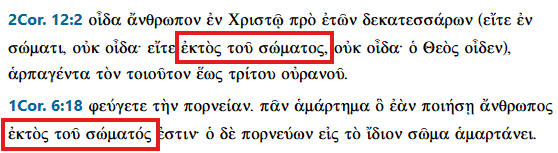
This is the interpretive key that unlocks the meaning of the phrase in 2 Corinthians 12:2-3. Paul used the same phrase, writing to the same people, in his previous letter. Before we can understand what he means by it in 2 Corinthians 12 we need to understand what he means by it in 1 Corinthians 6.
A Corinthian slogan
The sentence “every sin a person commits is outside the body” has puzzled interpreters for centuries. Some English translations add the word “other” as in “every other sin” in an attempt to clarify Paul’s statement. However, other does not appear in the Greek text of Paul’s letter. On the surface it appears to be Paul’s claim that all sins except sexual immorality are somehow external to the body. But this creates an immediate problem. What about drunkenness? Gluttony? Suicide? These clearly involve the body. If Paul is saying that all other sins do not involve the body, that would appear to be a contradiction. Since Paul did not write that word, we should not read it into his meaning.
There is a better explanation, but it requires a brief word about how ancient letters worked.
Diatribe
Ancient writers, including Paul, sometimes used a rhetorical technique called diatribe. In a diatribe the writer imagines an opponent or objector and quotes their position before refuting it. The quoted position is not the writer’s own view, it is the view being challenged. Modern readers miss this because we expect quotation marks to signal when someone else is being quoted. Ancient Greek manuscripts had no such punctuation. The reader was expected to recognize the shift from the writer’s voice to the objector’s voice from context.
Paul uses this technique repeatedly in 1 Corinthians (and in Romans). He quotes a Corinthian slogan and then immediately corrects it. A slogan in this context is a short memorable statement the community had adopted to justify their behavior. Recognizing which statements are Corinthian slogans and which are Paul’s own words is essential to understanding the letter correctly.
Not Paul’s statement
Richard B. Hays, a respected New Testament scholar, argues that “every sin a person commits is outside the body” is not Paul’s statement at all. It is a Corinthian slogan that Paul quotes in order to refute it. Hayes illustrates it this way:
“Paul: Flee fornication!
Corinthians [objecting]: [But why?] Every sin a person commits is outside the body.
Paul: But the fornicator sins against his own body.”1
Hays concludes that diatribe, or the slogan argument, is the better explanation of how to understand 1 Corinthians 6:18.2
This reading fits the broader context of 1 Corinthians perfectly. Paul engages several Corinthian slogans throughout the letter, each reflecting the same underlying assumption. “All things are lawful” (1 Cor. 6:12; 10:23), a slogan Paul quotes twice before qualifying it. “Food for the stomach and the stomach for food” (1 Cor. 6:13), another slogan Paul quotes before countering it. In each case the slogan reflects the Corinthian view that physical acts have no moral or spiritual significance. They claimed that what matters is the spirit or mind, not the body.
The proto-Gnostic background
This framework did not arise in a vacuum. The Corinthian slogan reflects assumptions that had been embedded in Greek culture for centuries. Plato taught that the soul is the true self, the body is an inferior prison, and genuine knowledge comes through the mind transcending bodily existence. By the first century, elements of Platonic dualism had become influential throughout much of the Hellenistic world that shaped Corinthian culture.3 4
What the Corinthians were doing was applying these cultural assumptions to their Christian faith, and the results were scandalous. They visited prostitutes (1 Cor. 6:15-16), got drunk at the Lord’s Supper (1 Cor. 11:21), and dismissed bodily resurrection as unnecessary (1 Cor. 15:12). Their conclusion was that the body is irrelevant to spiritual standing, so what you do with it does not matter. Paul dismantles this framework systematically across the entire letter precisely because it was producing real moral and theological ruin in the community. The body belongs to the Lord (1 Cor. 6:13). The body is a temple of the Holy Spirit (1 Cor. 6:19). The body will be raised (1 Cor. 15:42-44). Paul’s consistent message is the direct opposite of the Corinthian slogan: the body matters profoundly.
Paul’s own usage establishes the meaning
Here is the argument stated plainly, beginning with a rule of basic interpretive consistency: an author’s own prior usage of a phrase is the primary evidence for what he means by it. Paul used ektos tou sōmatos in 1 Corinthians 6:18 in a context where it clearly does not mean the soul departing the body.
Now apply the traditional reading consistently. If ektos tou sōmatos means “the soul departing the body,” then 1 Corinthians 6:18 says: every sin a person commits involves the soul departing the body. That is not a minor theological awkwardness. It is nonsense. No interpreter has ever argued that sinning requires the soul to temporarily vacate the body, because that reading is obviously absurd. But intellectual consistency demands it if the traditional reading of 2 Corinthians 12 is correct. The traditional view cannot survive being applied to both occurrences of the identical phrase in the same body of correspondence written to the same community.
When the identical phrase appears in 2 Corinthians 12:2 the burden of proof falls entirely on anyone claiming Paul suddenly means something categorically different, namely full soul departure. As Rodríguez observes, “the phrase ‘outside the body’ is employed only once more by Paul, in 1 Corinthians 6:18. Certainly Paul is not saying that sins are committed by a bodiless entity who resides inside the body.”5 The meaning Paul established in his own prior usage cannot suddenly become evidence for the soul leaving the body simply because that is what the traditional view needs it to mean.
The vision framework
There is one more observation worth making. Paul introduces this entire section with the words “visions and revelations from the Lord” (2 Cor. 12:1). That is the category under which he places his experience before he describes it. A vision is not an out of body experience. It is a revelatory experience in which God shows a prophet something real without requiring physical transportation or soul-body separation.
The biblical pattern is consistent. Isaiah saw the Lord high and lifted up (Isa. 6:1) without dying. Ezekiel was taken to Jerusalem “in visions of God” (Ezek. 8:3) while remaining physically in Babylon (Ezek. 11:24). John received the Revelation while “in the Spirit” (Rev. 1:10) without leaving his body. These experiences were real, extraordinary, and revelatory, and none of them required the soul to depart the body.
Paul’s uncertainty about whether his experience was “in the body or outside the body” maps perfectly onto this visionary framework. Was he physically transported to paradise? Or did he experience it as an overwhelming vision? He does not know. And crucially, neither option requires his soul to have left his body.
Conclusion
A Platonic reading of 2 Corinthians 12:2-3 assumes that “outside the body” supports the notion of the soul departing the body. But that reading cannot survive a simple test: apply it consistently to both occurrences of the identical phrase in Paul’s correspondence with the same community. If ektos tou sōmatos means the soul departing the body in 2 Corinthians 12, it must mean the same in 1 Corinthians 6:18, where Paul would be saying that every sin involves the soul temporarily leaving the body. No one believes that, because it is absurd on its face.
The traditional reading therefore depends on Paul meaning something categorically different by the same phrase in the same correspondence to the same community, with no signal that anything has changed. That is not exegesis. It is importing a conclusion the text refuses to support. What Paul experienced was either a physical transportation to paradise or an overwhelming revelatory vision. Neither requires a soul to leave a body, and Paul himself never claimed otherwise.
Read on its own terms and interpreted through Paul’s own established usage, 2 Corinthians 12:2-3 does not support the Platonic view of an immortal separable soul. It undermines it, just as the series on The Immortal Soul has argued from the beginning.
References
- Hays, Richard B.. First Corinthians: Interpretation: A Bible Commentary for Teaching and Preaching (p. 171). Presbyterian Publishing Corporation. Kindle Edition.
- Hays, Richard B.. First Corinthians: Interpretation: A Bible Commentary for Teaching and Preaching (p. 171). Presbyterian Publishing Corporation. Kindle Edition.
- Zandman, Herm J. G. “Historical Tension Between the Holistic and Dualistic View of Man in the Church.” In Die Skriflig 46, no. 1 (December 2012): 3.
- Hays, Richard B.. First Corinthians: Interpretation: A Bible Commentary for Teaching and Preaching (p. 167). Presbyterian Publishing Corporation. Kindle Edition.
- Angel Manuel Rodríguez, “2 Corinthians 12:2, 3,” Biblical Research Institute, Seventh-day Adventist Church. https://adventistbiblicalresearch.org/articles/2-corinthians-12-2-3.