
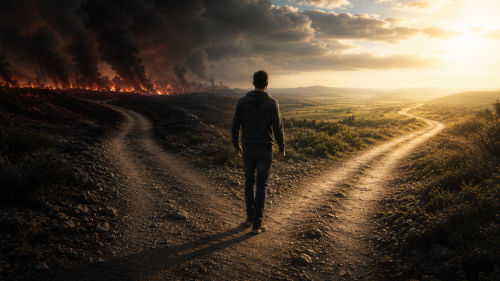
Paul opened Ephesians 2 with a grim picture. We were dead. Not spiritual zombies who could not respond to God, but people walking a road that ended in judgment and death. We followed the flesh. Not a sinful physical body, and not an inherited corrupt nature, but a capacity for sin that every person carries and acts on by choice. We were “by nature children of wrath.” Not because we inherited guilt at birth, and not because we inherited a corrupt or sinful nature, but because a life spent chasing selfish desire naturally leads to wrath.
Then Paul writes two of the most important words in the whole letter: “But God” (v. 4). Mercy steps into our story and changes where it was headed. Verses 5 through 7 show us how.
Made Alive Together: The Baptism Connection
Paul says God “made us alive together with Christ.” Look closely at that wording. Paul does not say we were made alive “in Christ.” That phrase, “in Christ,” appears constantly in this letter, but not here. Instead he says we were made alive “with Christ.” That specific phrase points straight back to Romans 6:4-5, where Paul describes baptism: we are buried with Christ in death, and just as He was raised, we now walk in a new kind of life.
This is not an accident of phrasing. Paul is describing baptism here too. In the water, we die with Christ. We leave the old road behind, the one heading toward judgment and death. Then we rise with Him into new life. Ephesians 2:5 and Romans 6 use the same picture because they describe the same event.
Saved From What, Exactly?
Paul does not leave the word “saved” vague. Look back at verses 1 through 3. We were on a road that would have ended in eternal death. We followed “the ruler of the power of the air,” and because of what we did under his influence, we were children of wrath, headed toward the fate that title implies.
God’s mercy did not simply make our lives a little better. It pulled us off the road we were actually on. That is the full weight of the word “saved” here. Grace did not repair a flaw we were born with. Grace rescued us from where we were going.
Seated With Christ
Verse 6 goes further still. We are not just made alive and raised. We are seated with Christ in the heavenly realms. Again, this is not about a place. It is about position. We went from serving a tyrant, and facing the penalty that service carried, to sharing in Christ’s own honored place.
Daniel described the righteous shining “like the brightness of the heavens… like the stars forever and ever” (Dan. 12:3). Jesus said something almost identical: “the righteous will shine like the sun in the kingdom of their Father.” (Matt. 13:43). Paul is painting the same picture. The reversal from wrath to honor could not be more complete.
Not Just for Us
Verse 7 tells us why God did all this. He did not rescue us only for our own good. He also did it to put His grace on display. Andrew Lincoln explains it well: “What God has done in making believers alive with Christ, raising them up with him and seating them with him in the heavenly realms, he has done not only for their sake but also as part of the larger purpose of displaying the richness of his grace.”1
This balances what Paul said earlier in the chapter. His wrath shows His justice. Our rescue shows His mercy and the reward that waits for those who love Him. Both truths about God stand side by side in this passage.
Calvinism teaches that “made alive” is a description of God invisibly regenerating a sinner who cannot respond on his own, before that sinner is even able to believe. But Paul frames this moment in the language of baptism, a step Scripture consistently ties to belief (Acts 2:38; 16:31-33). This is not a hidden work done to someone incapable of responding. It is a real rescue that takes place when a person unites with Christ in death and rises to walk the new of life. Read this way, the passage describes God rescuing someone from a path they were on, not God overriding someone’s will who never chose to choose Him.
The Takeaway
We were headed somewhere. Wrath was not a label stamped on us at birth. It was the road to death our decisions put us on. In baptism, we died to that way of living and rose to a new one. God did not just spare us from eternal death, He did much more. He raised us, gave us a new standing, and put His own generosity on display in the process.
That is not a small rescue. That is the gospel.