
Ask ten Christians what happens the moment a believer dies, and you will likely get ten different answers. Some will say the soul goes straight to heaven. Others will say it waits in Hades, either in comfort or in torment, until the resurrection. Still others will mix in ideas about purgatory, or guardian angels, or loved ones watching over us from above. Funerals are full of language about a soul that is “finally home,” “at peace,” or “in a better place,” spoken with total confidence. The problem is none of those ideas comes from the Bible.
The Bible actually says very little about the intermediate state between death and resurrection, and what it does say points somewhere different than where most of our traditions point. Part of the reason is a word most of us think we already understand: soul. We picture it as a separate piece of us, something that can detach from the body and keep going on its own. The Bible does not teach this, and once you see what it actually says, a lot of the confusion around death starts to clear up.
Scripture’s dominant picture of death is sleep: unconscious, restful, and temporary, waiting for the resurrection. That image shows up dozens of times across both testaments, and it sits at odds with most of what gets repeated at gravesides and in casual conversation.
Why I wrote The Sleeping Dead
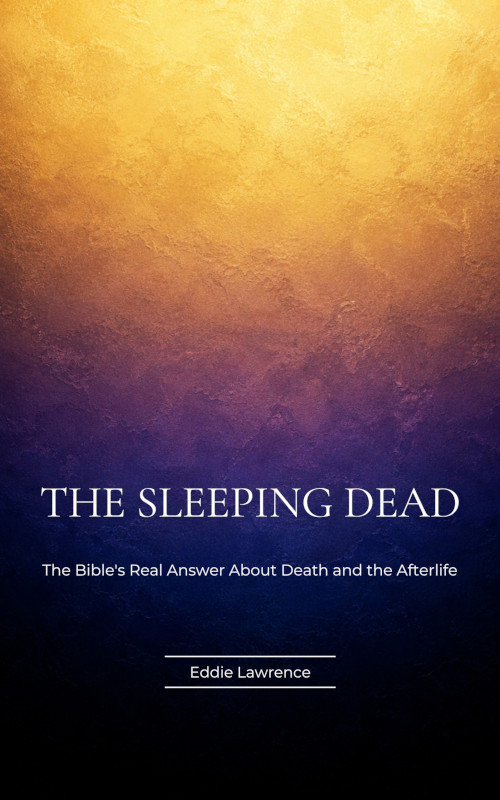
That is why I wrote The Sleeping Dead: The Bible’s Real Answer About Death and the Afterlife. Not to add another opinion to the pile, but to go back to the text itself and ask what it actually says about death and resurrection, verse by verse, with nothing assumed.
So where did all the other ideas come from? That question has a real answer, and it is not a flattering one for the tradition most of us inherited. The book traces it out, but the short version is this: somewhere along the way, a borrowed idea started to feel like the Bible’s own teaching. This book is an attempt to set the record straight.
Why should you care?
Fair question. This is not a topic that keeps most Christians up at night. Here is why I think it matters anyway.
First, ask yourself what the resurrection is actually for. If the soul goes straight to heaven at death, the resurrection and the judgment become a formality, just getting your body back after the part that really matters already happened. But the New Testament doesn’t treat it that way. Paul says if there is no resurrection, our faith is empty and we are the most pitiable people on earth (1 Corinthians 15:17-19). The traditional view quietly makes the resurrection optional. The Bible does not.
Second, this question has consequences for how we pray and what we believe about the dead. Entire systems of prayer to Mary and the saints, purgatory, and intercession for the dead rest on the assumption that the dead are conscious. If they are asleep, that foundation is gone, and praying to them is not a small mistake.
Third, the Bible consistently reaches for sleep as its picture of death, not heaven, not Hades, not an immortal soul in transit. The Holy Spirit’s word choice was not careless. It shapes how we are supposed to face death, grieve it, and hope beyond it.
Why is it free?
I am offering the book for free and under a public domain dedication; digital editions are available here for free. It is free because of a conviction I hold about ministry and money. The principle comes from Matthew 10:8, where Jesus told His disciples: “Freely you have received; freely give.” The gospel is not a product to offer for money, and the ministry of the Word should not be a revenue stream. If something I wrote helps you understand your Bible better, I want nothing standing between you and that help. Not a price tag, not a paywall, not a copyright, nothing. The paperback is on Amazon for those who prefer a physical book and it is priced as low as Amazon.com permits. Ditto for the Kindle edition, but you can get the epub version for your eBook reader free at the link above.
Read it, share it, and pass it on to anyone who could use the encouragement.