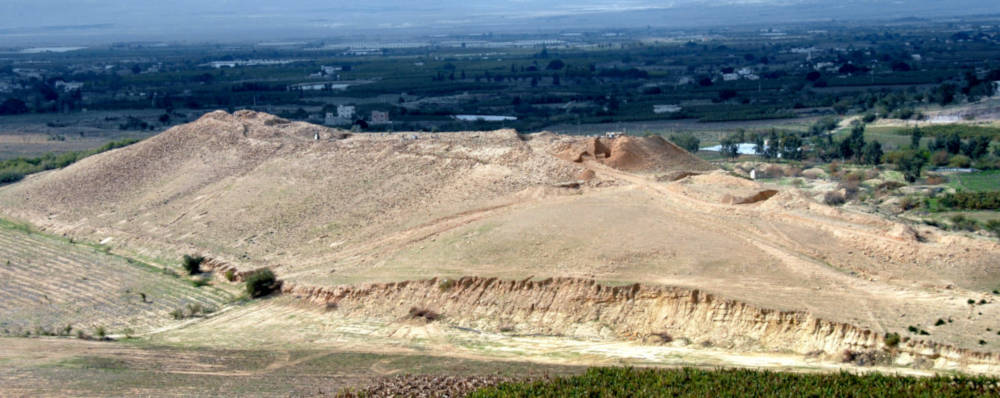
How well does the date of the destruction of Tall el-Hammam line up with the Bible’s chronology for the destruction of Sodom? We’ve already considered that Tall el-Hammam is in the right place to be Sodom. It’s also been observed that Tall el-Hammam contains the right stuff to be Sodom. However, if Tall el-Hammam’s destruction was hundreds of years before or after the time of Abraham, it can’t be Sodom.
In the previous blog post and accompanying video, we compared the area of Tall el-Hammam with the Bible’s description of the location of Sodom. As a candidate for the ruins of Sodom, Tall el-Hammam definitely meets the Bible’s geographical criteria. If Tall el-Hammam is Sodom, the artifacts from the excavations should also be consistent with the Bible’s description. What have archeologists discovered at Tall el-Hammam?
Size and architecture
The Bible describes Sodom as a fortified city based on the fact that it had a gate.
The two angels came to Sodom in the evening, and Lot was sitting in the gate of Sodom. When Lot saw them, he rose to meet them and bowed himself with his face to the earth (Gen. 19:1 ESV)
The destruction of the cities of Sodom and Gomorrah is one of the best known events of the Bible. The story’s lessons are significant and relevant to modern life. Be that as it may, before we tackle those lessons (in a future article), let’s consider recent archaeological discoveries which shed light on the ancient cities.
Where was Sodom?
Until the 20th century most biblical scholars considered Sodom to be at the northern end of the Dead Sea. Of course, they did not know the exact location, but they based their conclusions upon a reading of the text in Genesis.
Why did God command the circumcision of a ninety-nine year old man? God changed Abram’s name to Abraham in Genesis 17 and along with the new name came a new covenant. Why another covenant? Wasn’t one already made in Gen 15?
It appears that Abraham participated in two covenants. (1) The unilateral covenant in Gen 15 where only God obligated Himself with no requirements from Abraham (other than faith). (2) The covenant of circumcision in Gen 17. At first these don’t appear to be two covenants, but one. However, Acts 7:8 calls the Gen 17 covenant the “covenant of circumcision” after referring to the Gen 15 covenant separately in the preceding verses. Therefore, it seems that these were two covenants
God has added the rite of circumcision to the existing covenantal relationship He established in Gen 15. Why did God add circumcision as a sign of the covenant (Gen 17:11)? In what way was circumcision a sign? What did this rite mean to people in that part of the world during that time in history?
In certain Christian circles it is presently fashionable to opine that Hagar was sexually exploited and abused by Abraham and Sarah. Is this true? Was Hagar mistreated when Sarah gave her to Abraham as a concubine? What were the circumstances which gave rise to this situation?
God promised Abraham a child when He called him out of Ur. Since Sarah and Abraham were a married couple, it was perfectly reasonable for them to conclude that Sarah would be the mother of Abraham’s children. However, after ten years of waiting (Gen 16:3) it seems they began to question that conclusion.
Can we blame them for questioning? After a decade of waiting they still didn’t have the child God promised. Sarah may have thought that her previous conclusion about being the mother of the promised child was in reality only an assumption. After all, God promised Abraham offspring, not Sarah (Gen 12:2, 7). Maybe Sarah decided she would not be the conduit of this blessing to her husband.