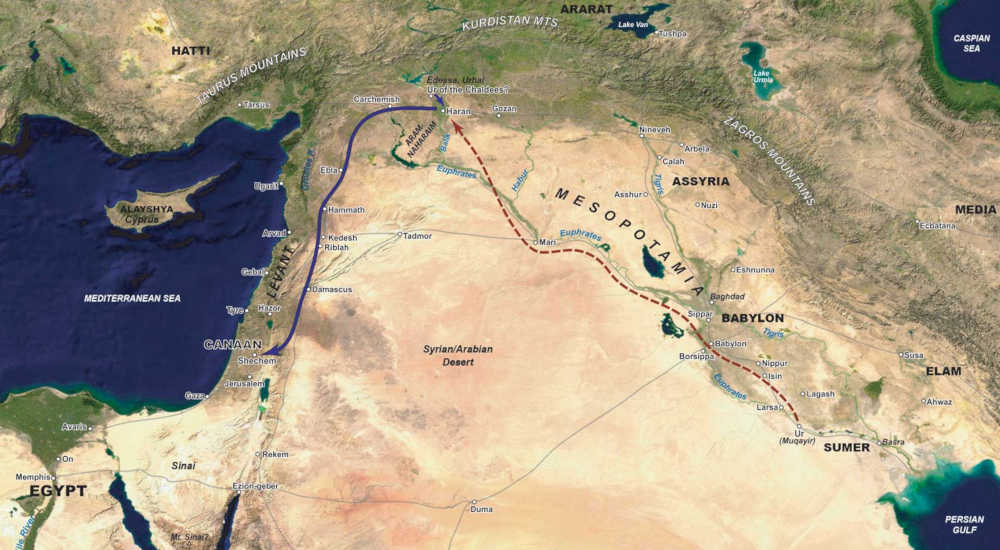
The name “Hebrew” probably doesn’t derive from an ancestor of Abraham, but rather from the word “habiru.” The first time the word “Hebrew” appears in the Bible it describes Abram (Abraham):
“Then one who had escaped came and told Abram the Hebrew, who was living by the oaks of Mamre the Amorite, brother of Eshcol and of Aner. These were allies of Abram.” (Gen. 14:13 ESV)
Many Bible students speculate that the word Hebrew derives from “Eber” who was one of Abraham’s ancestors. According to Genesis 11, Eber was Abraham’s great-great-great-great grandfather and Eber himself was the great-great grandson of Noah. Eber had two sons and, combined, they in turn had more than a dozen sons. Clearly Eber’s descendants were numerous.
Why aren’t all of Eber’s descendants called Hebrews?
If the Bible called Abraham a Hebrew because he descended from Eber, why didn’t it call all of Eber’s descendants Hebrews? The Bible restricts the description of Hebrew only to the nation of Israel and the Patriarchs who beget them. Abraham’s first-born son, Ishmael, was a descendant of Eber, but the Bible never refers to him as a Hebrew. The same is true of Lot and Esau (and many others). Since this is the case, we have reason to doubt that Abraham was called a Hebrew because of his ancestor Eber.1
Continue reading →