
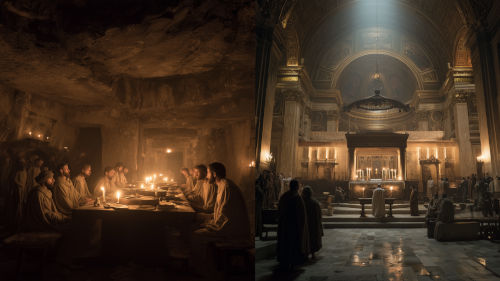
Picture this: You’re a Christian in the year 310 AD. You meet in secret. You hide your faith from neighbors. Roman soldiers could arrest you for believing in Jesus. Just a few years later, emperor Constantine legalized Christianity in the Roman Empire. Within a few generations, Christianity goes from outlawed to embraced, then elevated to the empire’s official religion. What happened? And how did this dramatic shift plant seeds that eventually grew into today’s denominations?
The moment everything changed
In 313 AD, Emperor Constantine issued the Edict of Milan. This law made Christianity legal throughout the Roman Empire. No more hiding. No more persecution. Christians could serve God openly.
Constantine claimed he had a vision before a crucial battle. He saw a cross in the sky with the words “In this sign, conquer.”1 Whether you believe his conversion was genuine or political, his decision transformed Christianity forever.
By 380 AD, Christianity wasn’t just legal, it was mandatory. Emperor Theodosius made it the empire’s official religion. Pagan temples closed. Christian churches received tax exemptions. Sunday became a legal day of rest. Sound familiar? Many policies from this era still shape our world today.2
The benefits and the baggage
Going from persecuted to preferred brought obvious advantages. Christians could meet openly. They gained social respect. Emperors encouraged donations to Christian institutions. But all this came with a price. Gonzalez observes that Christian worship began mirroring imperial ceremony:
“After Constantine’s conversion, Christian worship began to be influenced by imperial protocol. Incense, which was used as a sign of respect for the emperor, began appearing in Christian churches. Officiating ministers, who until then had worn everyday clothes, began dressing in more luxurious garments—and soon were called ‘priests,’ in imitation of their pagan counterparts, while the communion table became an ‘altar’—in opposition to the instructions found earlier in the Didache. Likewise, a number of gestures indicating respect, which were normally made before the emperor, now became part of Christian worship.
An interesting example of this had to do with prayer on Sundays. At an earlier time, the practice was not to kneel for prayer on Sundays, for that is the day of our adoption, when we approach the throne of the Most High as children and heirs to the Great King. Now, after Constantine, one always knelt for prayer, as petitioners usually knelt before the emperor. The custom was also introduced of beginning services with a processional. Choirs were developed, partly in order to give body to that procession. Eventually, the congregation came to have a less active role in worship.”3
These shifts in practice reflected a deeper shift in the church’s posture toward power. As imperial customs shaped liturgy, imperial interests began shaping theology. The church gained influence, but at the cost of independence.
When emperors decide doctrine
Constantine soon faced a problem. Christians were arguing about Jesus’s nature. A priest named Arius taught that God the Father created Jesus—making him less than fully divine. This controversy was splitting churches and threatening imperial unity.
Constantine’s solution? Call a council. In 325 AD, bishops gathered in Nicaea to settle the debate. They rejected Arius’s teaching and affirmed that Jesus is fully divine, “begotten, not created,” and of the same substance as the Father. They wrote this belief into the Nicene Creed.
But here’s the key question: Was this council motivated by spiritual truth or political stability? Probably both. Emperors cared about religious unity because it meant imperial unity. Divided churches meant divided empires.
The Council of Chalcedon in 451 AD followed the same pattern. Christians were arguing about whether Jesus was truly human or only appeared human. The council declared Jesus was fully God and fully human simultaneously.
These councils established crucial biblical truths. But they also established a precedent: when Christians disagree, call a council. Let authorities decide doctrine and write a document about it. Then, make everyone conform. Those who the church deemed heretics were now enemies of the state.4
The conversion problem
But here’s what emperors couldn’t legislate: genuine faith. When Christianity became the empire’s official religion, “conversion” became politically smart. Want a government job? Become a Christian. Seeking social advancement? Get baptized. Looking for business connections? Join a church.
Suddenly, churches filled with people who had never experienced true conversion.5 They adopted Christian terminology but not Christian transformation. They followed Christian rituals but not the Christian life.
This created a massive problem that still affects churches today. How do you distinguish between genuine believers and cultural Christians? How do you maintain spiritual standards when membership brings social benefits?
The early church had been small, committed, and costly to join – it could cost you your life! Now it was large, popular, and profitable to join. Persecution had kept the uncommitted away. Preference brought them flooding in.
The rise of Papal power
Meanwhile, the Roman Empire was crumbling. Barbarian tribes invaded from the north. The western empire collapsed in 476 AD and the last Roman emperor fell. This created a massive power vacuum. Who would lead? Who would maintain order? Who would preserve civilization? In Rome, the bishop stepped forward. He already led the city’s churches. Now he began leading its politics too. As the empire faded, the papacy grew.
The word “pope” simply means “father.” Originally, people used it for any respected bishop. Gradually, it became the exclusive title of Rome’s bishop. By the end of this period, the pope claimed authority over all churches in the former western empire.
But concentrated power creates concentrated problems. When one person claims to speak for God, what happens when he’s wrong? When human authority replaces biblical authority, how do you correct course? When political power mixes with spiritual authority, which takes precedence?
The seeds of division
These developments—legalization, councils, papal authority—solved immediate problems but created long term and lasting tensions. They established patterns that still influence Christianity today:
The relationship between church and state. Should government support churches? Should churches influence politics? Christians still debate these questions because Constantine’s decision made them unavoidable.
The role of authority in doctrine. Who decides what Christians must believe? Individual conscience? Church councils? The authority structures created in this era still shape these discussions.
The balance between unity and truth. Constantine wanted Christian unity to support imperial unity. But what happens when unity requires compromising truth? Or when defending truth requires breaking unity?
These weren’t just ancient problems. They’re our problems too.
Lessons for today
Every church faces the tension between truth and unity. The early church’s response to imperial favor reveals both wisdom and weakness. They defended essential doctrines about Jesus’s nature. But they also began substituting human authority for biblical authority. This opened the door for creeds and council decisions to assert dominance. Over time, these began to function with authority that rivaled Scripture. Theological disagreement became political rebellion. State power became a tool for enforcing religious conformity.
These developments didn’t create denominations immediately. That process took centuries more. But they planted seeds that eventually grew into the diverse Christian landscape we see today.
Understanding this history helps us navigate similar challenges. When power and politics enter our churches, how do we respond? When unity and truth seem to conflict, which do we choose? When human authorities claim divine authority, how do we test their claims?
The apostle John wrote, “Test the spirits to see whether they are from God” (1 John 4:1). This advice became essential when Christianity moved from the catacombs to the cathedral. It remains essential today.
References
- Schaff, Philip. History of the Christian Church – From The 1st To The 19th Century (All 8 Volumes) (Kindle Locations 35704-35705). www.DelmarvaPublications.com. Kindle Edition.
- González, Justo L. . The Story of Christianity: Volume 1: The Early Church to the Dawn of the Reformation (pp. 142-143). HarperCollins. Kindle Edition.
- González, Justo L. . The Story of Christianity: Volume 1: The Early Church to the Dawn of the Reformation (pp. 143-144). HarperCollins. Kindle Edition.
- González, Justo L. . The Story of Christianity: Volume 1: The Early Church to the Dawn of the Reformation (p. 190). HarperCollins. Kindle Edition.
- González, Justo L. . The Story of Christianity: Volume 1: The Early Church to the Dawn of the Reformation (pp. 144-145). HarperCollins. Kindle Edition.