
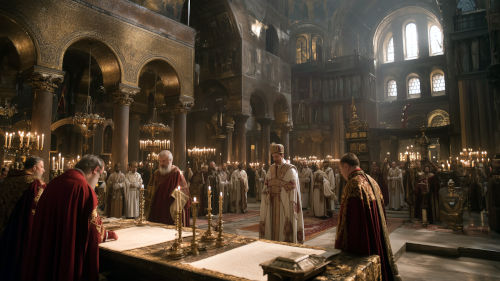
July 16, 1054 AD started like any other day in Constantinople. By evening, Christianity had officially split for the first time in its thousand-year history. A Roman church representative walked into Hagia Sophia, the magnificent cathedral of the Eastern church. He placed a letter of excommunication on the altar, then walked out. The letter condemned the Patriarch of Constantinople and anyone who followed him.
One thousand years of Christian unity ended with a piece of parchment. How did it come to this? And what does this ancient split teach us about handling disagreements in our churches today?
Growing apart
The division didn’t happen overnight. For centuries, Eastern and Western Christianity had been drifting apart like continents slowly separating. Geography played a role. Rome anchored the West. Constantinople (modern Istanbul) led the East. These cities sat over 800 miles apart in an age when communication traveled at the speed of horses.
Language created barriers. Western churches spoke Latin while Eastern churches spoke Greek. Western Christianity developed a more legal, organized approach. Eastern Christianity emphasized mystery and contemplation. Different cultures produced different ways of following Jesus.
But the real problem was power. Who had authority over the entire Christian church?
The authority question
After the Roman Empire collapsed in the West, the Pope filled the power vacuum. He claimed authority over all Christians everywhere. This made sense to Western Christians who had watched their bishops provide leadership when governments failed. Eastern Christians disagreed. They had their own bishops, their own emperor, their own thriving civilization. Why should a bishop in distant Rome tell them how to run their churches?
The Eastern church operated more like a family of equal siblings. Major bishops held equal authority in their regions. Important decisions required consensus among these leaders. The Western church developed more like a corporation. The Pope served as CEO, with other bishops reporting to him. This provided clear leadership but concentrated enormous power in one person.
The breaking points
By 1054, specific disagreements and rivalries made the underlying tensions explosive. According to Philip Schaff in History of the Christian Church,1 there were three primary causes of East-West division:
1. Political and Ecclesiastical Rivalry
The Patriarch of Constantinople (backed by the Byzantine Empire) and the Bishop of Rome (connected to the new German Empire) competed for supremacy and influence.
2. Growing Papal Centralization
As the Roman church centralized more power through the papacy, its overbearing conduct alienated Eastern churches.
3. Divergent Development Paths
The Greek (Eastern) church maintained traditional theology and claimed perfection in their existing creed. The Roman church became progressive and dynamic, developing new theological ideas and expanding into new territories.
Contributing factors
Schaff also lists several factors which contributed to the wedge between East and West:2
The Filioque Controversy: Does the Holy Spirit proceed from the Father alone, or from the Father and the Son? Western churches had added “and the Son” (filioque in Latin) to the Nicene Creed without consulting Eastern churches. Eastern leaders saw this as both theologically wrong and procedurally arrogant.
Priestly Marriage: Eastern churches allowed married men to become priests. Western churches required celibacy.
Liturgical Practices: Rome withdrew the communion cup from laypeople, while the East continued giving both bread and wine.
The Immaculate Conception of Mary: Rome adopted the idea that Mary was free of original sin and remained free of personal sin. The Eastern churches rejected this.
Add political pressure, cultural pride, and centuries of growing mistrust, and theological differences became weapons of war.
The Point of No Return
The final crisis began when the Pope claimed authority over churches in southern Italy that had traditionally followed Eastern practices. The Patriarch of Constantinople protested. The Pope sent representatives to resolve the dispute.
Instead of negotiating, the papal representatives issued ultimatums. They demanded the Eastern church submit to Roman authority and adopt Western practices. When Eastern leaders refused, the representatives excommunicated them.3 The Patriarch responded by excommunicating the papal representatives.
For the first time in Christian history, major church leaders formally declared each other outside the faith. The church that had survived Roman persecution, barbarian invasions, and theological controversies finally split apart.
Lessons for Today
The Great Schism reveals patterns that still affect churches today:
Communication breakdown leads to conflict escalation. When Eastern and Western leaders stopped talking, misunderstandings multiplied. When they finally communicated, they spoke past each other instead of listening.
Cultural differences create theological tensions. Different cultures naturally emphasize different aspects of biblical truth. This diversity can enrich the church, but it can also create division when people assume their cultural approach is the only biblical approach.
Power struggles corrupt spiritual discussions. The Great Schism wasn’t really about communion practices or married priests. It was about who controlled Christianity’s future. When spiritual discussions become power contests, everyone loses.
Small issues become major conflicts without wise leadership. Patient dialogue and mutual respect could have resolved many of the specific disagreements. But leaders on both sides chose confrontation over the priorities of God’s kingdom.
The Ongoing Challenge
Today’s churches face similar tensions, splitting over worship styles, leadership structures, and theological interpretations. The Great Schism offers both warning and wisdom: pride, power, and poor communication destroyed unity over issues largely absent from New Testament teaching.
Much of what divided East and West—clerical celibacy, papal supremacy, liturgical language, and the filioque clause—represented traditions developed centuries after the apostles, not biblical mandates. These disputes elevated human customs to the level of divine command, claiming authority that belongs only to God.
Paul asked the Corinthians, “Is Christ divided?” (1 Cor 1:13). The question still challenges us. When Christians fight over non-essential traditions rather than biblical truth, the world watches and the gospel’s credibility suffers.
The challenge isn’t avoiding all disagreement; the New Testament records plenty of Christian conflict. The challenge is distinguishing between essential doctrine and secondary issues, handling disagreement in ways that honor Christ while maintaining spiritual unity.
The Great Schism reminds us how much damage we can do when we “teach as doctrine the precepts of men” (Mt. 15:9).
References
- Schaff, Philip. History of the Christian Church – From The 1st To The 19th Century (All 8 Volumes) (Kindle Locations 57484-57505). www.DelmarvaPublications.com. Kindle Edition.
- Schaff, Philip. History of the Christian Church – From The 1st To The 19th Century (All 8 Volumes) (Kindle Locations 57420-57440). www.DelmarvaPublications.com. Kindle Edition.
- González, Justo L. . The Story of Christianity: Volume 1: The Early Church to the Dawn of the Reformation (pp. 312-314). HarperCollins. Kindle Edition.