
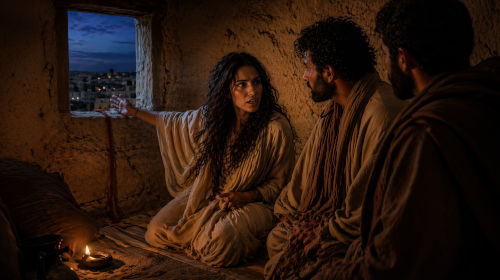
Most Bible readers know the basic outline: two Israelite spies slip into Jericho, a woman named Rahab hides them, she hangs a scarlet cord from her window, and her household survives when the walls come down. Familiar story. But somewhere along the way, someone decided to clean it up and claimed that Rahab was not a prostitute at all, but an innkeeper.
Now, perhaps she did operate an inn out of her home. That would not be surprising given the historical association between the two professions. But an innkeeper is not what the biblical text calls her, and the story of how that label got attached to Rahab is worth examining.
The Hebrew Settles It
The Old Testament identifies Rahab with the Hebrew word zonah (זוֹנָ֛ה). This word appears nearly ninety times in the Old Testament, and it never carries a favorable meaning. Standard Hebrew lexicons are uniform on this point: zonah means prostitute. There is no range of meaning here that might allow for innkeeper, hostess, or any other respectable alternative.
The ancient translators agreed. When Jewish scholars produced the Greek Septuagint (LXX), they rendered zonah with the Greek word pornēs (πόρνης), the root behind the English word pornography. The translators who knew both languages and both cultures chose it without hesitation. The biblical text, in both Hebrew and Greek, identifies Rahab as a harlot. There is no ambiguity to resolve.
Enter Josephus
So where does the innkeeper idea come from? Most likely from Flavius Josephus, the first-century Jewish historian. In his Antiquities of the Jews, Josephus refers to Rahab as an innkeeper rather than a prostitute.
But context matters here. Josephus wrote Antiquities specifically for a Greco-Roman audience. His goal was to present Jewish history in a favorable light to non-Jewish readers. Softening Rahab’s profession from harlot to innkeeper fits that agenda neatly. He had both social and literary reasons to reach for a more respectable term.
Interestingly, William Whiston, one of the most well-known English translators of Josephus, added a note that actually illuminates what Josephus may have been doing. Whiston wrote that it was common enough for innkeepers to also be harlots, or to maintain harlots, that the word for innkeeper was routinely used as a stand-in for the other.1 In other words, Josephus may have used a polite euphemism that his original readers would have understood perfectly. He did not so much deny Rahab’s profession as dress it in more acceptable language for his audience.
The Hebrew text, however, calls her what she was.
Why It Matters That She Was a Prostitute
This is not just a trivia correction. The identity of Rahab as a prostitute carries real theological weight.
Richard Hess, in his commentary on Joshua, notes that prostitutes and innkeepers shared a social association in the ancient Near East among West Semitic and Hittite cultures.2 This connection actually helps explain a practical detail in the story: why did the Israelite spies go to Rahab’s house in the first place?
A prostitute’s house was a good place to gather information without raising suspicion. The spies could blend in as customers, and no one would ask uncomfortable questions about strangers passing through. Rahab herself seems to have understood this cover. When the king’s men came looking, she hid the spies and misdirected the search party without missing a beat. She played the situation with remarkable composure, which suggests she understood they were posing as customers and used that to her advantage from the moment they walked through her door. Her house was also built into the city wall, making it an ideal location for a quick escape when the time came. Surely an advantage the spies noticed when selecting their lodging. None of that works as well if she was just running a bed and breakfast.
Rahab in the Hall of Faith
More importantly, consider what the New Testament does with Rahab. Matthew includes her in the genealogy of Jesus Christ (Mt 1:5). The writer of Hebrews places her in the hall of faith alongside Abraham, Moses, and Gideon (Heb 11:31). James holds her up as an example of faith demonstrated through action (Jas 2:25).
Grace, Not Tolerance
The point is not that God tolerated Rahab despite who she was. The point is that God saved her, used her, and honored her precisely as a demonstration of what grace does. A sanitized Rahab, respectable innkeeper, diminishes that story. A Rahab who was exactly what the Hebrew says she was makes the grace of God all the more striking.
Leave her as the text found her. The story is better that way.
References
- William Whiston, notes to The Works of Flavius Josephus, Complete and Unabridged, new updated ed. (Peabody, MA: Hendrickson Publishers, 1987), Antiquities 5.10, electronic edition.
- Walton, John H., ed. Genesis, Exodus, Leviticus, Numbers, Deuteronomy, Zondervan Illustrated Bible Backgrounds Commentary. Grand Rapids, Mich: Zondervan, 2009. 19.