
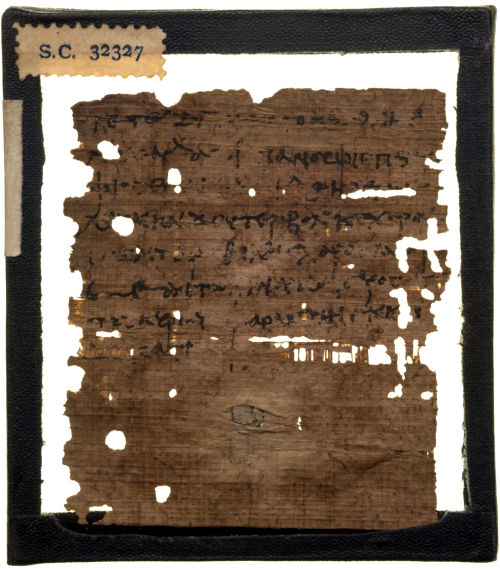
On Easter Sunday, my daughter asked me a question. Leading up to Easter, she heard the same claim again and again in social media posts and sermon videos, all driving toward the same dramatic punchline. She wanted to know what was real and what was hype. Her specific question was about tetelestai2 which is the Greek word translated “It is finished” in John 19:30.
She had heard that ancient people wrote tetelestai on business receipts to indicate that a transaction was “paid in full.” Therefore, when Jesus said it from the cross He was declaring that He had paid the debt of sin in full.
It’s a compelling illustration. It’s also not true. Tracing how it started turns out to be an interesting story.
What Tetelestai Really Means
Tetelestai is a form of the Greek verb teleo. That verb and its variants appear twenty-seven times in the New Testament, and the ESV renders it with words like finished, fulfilled, accomplished, ended, and pay. The form tetelestai itself appears only twice in the New Testament: John 19:28 and 19:30.
The standard Greek lexicon used by scholars, BDAG, lists three primary senses for teleo: (1) to complete or finish something, (2) to carry out or fulfill an obligation, and (3) to pay what is due.3 That third sense is real and it’s exactly how the word appears in Matthew 17:24 when Jesus speaks about paying the temple tax and in Romans 13:6 when Paul talks about paying government taxes. But when BDAG discusses John 19:30 specifically, it places tetelestai under senses one and two, not three. The financial sense exists, but the scholars who built the definitive Greek lexicon did not think it was the relevant sense for the cross.
Where the “Paid in Full” Claim Came From
The claim traces back to around 1915, when a scholarly reference work, Moulton and Milligan’s Vocabulary of the Greek New Testament, stated that “receipts are often introduced by the phrase τετέλεσται [tetelestai], usually written in an abbreviated manner,” and cited a set of ancient Egyptian papyrus documents as evidence.4 The abbreviation they refer to is tetel. Commentators picked that claim up, passed it into sermon culture, and it has circulated ever since.
Flawed Reference Material
The problem is that Moulton and Milligan worked from a flawed source. Papyrus experts Bernard Grenfell and Arthur Hunt published those papyrus documents in 1897, and that edition misstated the abbreviation. The receipts carried the abbreviation tetel, and Grenfell and Hunt expanded it as tetel(estai). This was a mistake that was later corrected. Regardless, this was the source available to Moulton and Milligan and they built their claim on it.
The official correction registry for papyrus documents later recorded the correction.5 6 7 As it turned out, seventeen of the papyrus receipts did not use the tetel abbreviation but wrote the full word out. They read not tetelestai but instead tetelonētai, meaning “customs has been paid.”8 That word derives from teloneō, the same root as telonēs which is the Greek word for tax collector. The receipts Moulton and Milligan referred to were customs transit documents recording cargo passing through gates and ports in Egypt, not receipts for paid-off debts. Scholars corrected the mistake. However, the sermon illustration kept going.
Scholarly Confirmation
Dr. Gary Manning, a professor at Talbot School of Theology, confirmed this in a 2022 article in which he examined these customs receipts.9 Every single one of the seventeen unabbreviated instances read tetelonētai. Manning also surveyed actual receipts for purchases and paid off debts, and this is what he found:
“None used the abbreviation τετελ or the word τετέλεσται. The purported meaning ‘paid in full’ for τετέλεσται is not found in any other ancient Greek sources (literary works, papyri or inscriptions). When τετέλεσται is used in these documents, it describes finishing all kinds of things: construction, sculpting, farm work, business arrangements, sewing linens, haircuts or even just the list of things to get done in a day.”
The very documents where this sermon folklore says we should see tetelestai do not contain the word!
Regarding the financial aspect, BDAG cites papyrus P.Fay. 36, a brick-making concession contract from 111-112 AD, as evidence that teleo can denote a financial obligation.10 But, that document uses telesein, the form meaning “to pay,” not tetelestai, and it records an obligation to pay, not a completed transaction.
What Jesus Actually Meant
John’s Gospel builds toward this moment from the beginning. Jesus speaks repeatedly of finishing the work the Father gave him (Jn 4:34, 5:36, 17:4). In John 19:28-30, John makes the connection to Scripture fulfillment explicit using two closely related Greek words in quick succession to show that Jesus knew all things were now completed and that Scripture was reaching fulfillment before He cried out “It is finished.”
Jesus, in His final breath, declared that He accomplished His mission. The whole sweep of redemptive history had arrived at its appointed end. This is staggering enough on its own terms; we don’t need a receipt story that preaches well to improve it.
Perpetuating a Misconception
My daughter was right to ask, and she asked the right question. Her goal was to separate the wheat from the chaff. This should be the goal of every Bible student.
Preachers and teachers carry a responsibility that goes beyond finding illustrations that land well with an audience. The “paid in full” story has circulated for decades precisely because it preaches well; it’s vivid, memorable, and emotionally satisfying. But those are not the same thing as truth. When people repeat claims without validating them against the primary sources, they trade the authority of Scripture for the authority of a good story. The plain meaning of tetelestai has anchored the church’s understanding of the cross since the beginning. It needs no embellishment. Our obligation is to proclaim what the text actually says and to do the hard work required to know the difference.
References
- Oxford, Bodleian Library MS. Gr. class. g. 21 (P): https://digital.bodleian.ox.ac.uk/objects/8e2e3e96-9030-4a93-8c8a-b00e1465a9d8/
- prononced teh-TEH-leh-stye
- BDAG, s.v. “τελέω,” 997.
- Moulton, James Hope, and George Milligan. The Vocabulary of the Greek Testament Illustrated from the Papyri and Other Non-Literary Sources. London: Hodder and Stoughton, 1914–1929. 630.
- P.Grenf. 2 50a (TM 11334). Soknopaiou Nesos, April 11, 142 AD. Duke Databank of Documentary Papyri. http://papyri.info/ddbdp/p.grenf;2;50a.
- P.Grenf. 2 50b (TM 11335). Soknopaiou Nesos, October 2, 145 AD. Duke Databank of Documentary Papyri. http://papyri.info/ddbdp/p.grenf;2;50b.
- P.Grenf. 2 50c (TM 11336). Philadelphia (Arsinoites), September 16, 147 AD. Duke Databank of Documentary Papyri. http://papyri.info/ddbdp/p.grenf;2;50c.
- Manning, Gary. “Paid in Full? The Meaning of τετέλεσται (Tetelestai) in Jesus’ Final Words.” Biola University Good Book Blog, April 20, 2022. https://www.biola.edu/blogs/good-book-blog/2022/paid-in-full-the-meaning-of-tetelestai-in-jesus-final-words.
- Manning, Gary. “Paid in Full? The Meaning of τετέλεσται (Tetelestai) in Jesus’ Final Words.” Biola University Good Book Blog, April 20, 2022. https://www.biola.edu/blogs/good-book-blog/2022/paid-in-full-the-meaning-of-tetelestai-in-jesus-final-words.
- P.Fay. 36 (TM 10883). Theadelphia (Arsinoites), August 30, 111 – August 28, 112 AD. Duke Databank of Documentary Papyri. http://papyri.info/ddbdp/p.fay;;36.