

When you hear the New Testament speak of “the flesh,” what comes to mind?
All of us also lived among them at one time, fulfilling the cravings of our flesh and indulging its desires and thoughts… (Eph. 2:3 BEREAN)1
For many Christians, we might conclude it refers to our physical bodies. We think Paul is warning us against physical desires and bodily appetites. We assume the path to holiness means suppressing our physical nature. As it turns out, that’s not what Paul means at all! Because of our assumptions about what the flesh is, many of us may be fighting the wrong enemy.
What We Might Mistake Flesh to Be
The confusion is understandable. When we hear “flesh,” we naturally think of our bodies. Another reason Christians may think this is due to pagan philosophy that crept into church doctrine centuries ago. The Greeks taught that the body was the prison of the soul. Matter was corrupt; spirit was pure. But that’s not the Bible’s view.2
Scripture doesn’t treat the body as inherently evil or as something opposed to the soul. The Hebrew language doesn’t even have a word for “body” as something separate from the soul.3 The Israelites saw humans holistically: physical form was a necessary part of being human.
Jesus recognized that flesh was weak (Mt 26:41), but He never called it sinful in itself.
What the Flesh Really Is
So what does Paul mean when he uses “flesh” in passages like Ephesians 2:3?
Paul often uses “flesh” (Greek: sarx) in a distinctive way. He’s not talking about your physical body. He’s describing your capacity for sin, weakness, and rebellion against God. Here’s how theologian Daniel Akin explains it:
“Most contemporary English translations (including the newest edition of the NIV) opt to translate sarx as ‘flesh,’ and it must be understood that in these passages, sarx refers to a capacity, not an ontological nature.”4
The flesh is not what you are, that is, your body. It’s a capacity within you; your potential to sin and/or rebel against God. It is not a force that compels us to sin, but a weakness that makes us susceptible to sin.
Scholar W.D. Davies puts it even more clearly: the flesh is “a corrupted not a corrupting element.”5 It’s the weak instrument that sin uses, not the ultimate source of sin itself.
The Biblical Evidence
Several passages make this clear:
Romans 7:18 – Paul says “I know that nothing good lives in me, that is, in my flesh; for I have the desire to do what is good, but I cannot carry it out.” But notice he distinguishes between himself as a person and the flesh as something within him. The flesh is where sin finds opportunity.
Romans 8:5-9 – Paul contrasts those who “set their minds on the things of the flesh” with those who “set their minds on the things of the Spirit.” He says Christians “are controlled not by the flesh, but by the Spirit.” This shows the flesh is an orientation or capacity, not your physical existence.
Galatians 5:16-17 – “the flesh craves what is contrary to the Spirit, and the Spirit what is contrary to the flesh. They are opposed to each other.” Two capacities. Two directions. One person.
Galatians 5:19-21 – Look at the “works of the flesh” Paul lists. Among them are jealousy, strife, anger, rivalries, envy. What do you notice about these works of the flesh? These aren’t bodily appetites, not physical sins. These are sins of the heart and mind.
Flesh Contrasted with Spirit
This is the key to understanding Paul’s teaching. The flesh and the spirit work in opposite directions within you. When Paul speaks of “spirit” here, he means your human spirit responding to God’s Holy Spirit. The flesh is your potential to yield to temptation. It pulls you toward self, sin, and independence from God:
“As the human spirit is the capacity to open one’s life to the influence of God, so the flesh is the capacity to hear and respond to temptation. The spirit leads life in one direction; the flesh, in the opposite direction.” 6
To paraphrase Akin, the spirit is your capacity to open your life to God’s influence. It draws you toward God, holiness, and surrender to His will. Think of it as two voices calling you. Two opposing forces within the same person pulling you in different directions.
God Made the Flesh Good
Here’s what you need to understand: the flesh, as God created it, is not evil. It’s necessary for human survival and flourishing. Remember Genesis 1:31? God looked at everything He made and called it “very good.” That includes your fleshly appetites and drives.
The impulses we have aren’t sinful in themselves. Hunger drives us to eat. Desire for connection prompts us to build relationships. The drive for comfort inspires us to create shelter. And a sex drive ensures reproduction. These drives are essential for life and civilization.
The problem isn’t the impulse itself. The problem is what happens when that impulse gets corrupted and twisted away from God’s design.
When Good Drives Go Bad
Every God-given drive has a created purpose. But every drive can also be corrupted:
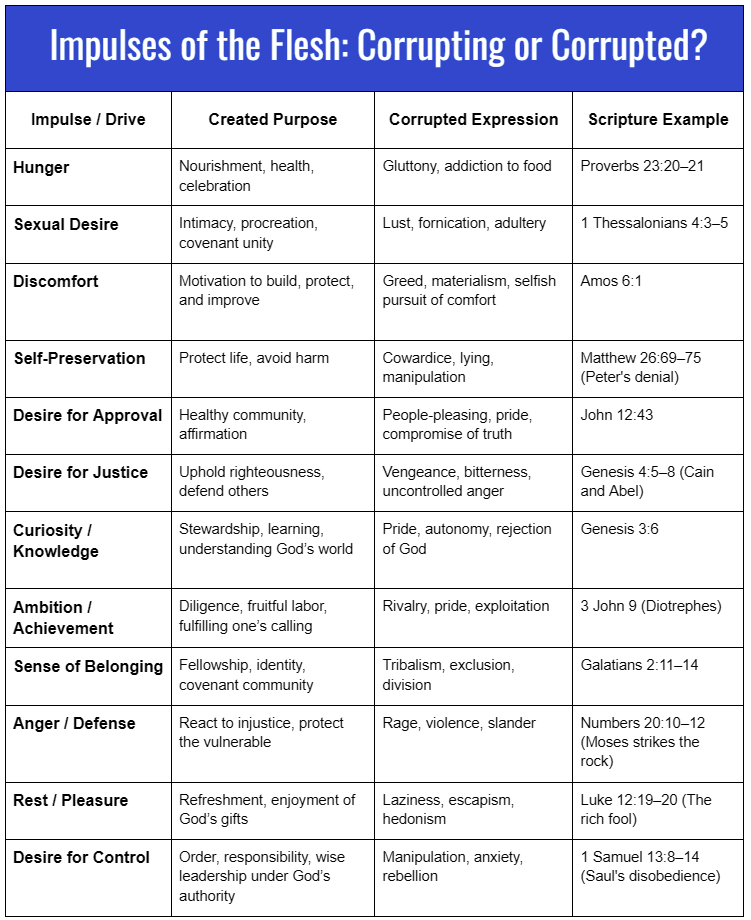
See the pattern? The drive itself comes from God. The corruption of that drive is where sin enters through the flesh.
What This Means for You
Understanding the flesh correctly changes everything. You don’t have to view your body as the enemy. Nor must you suppress every desire. You don’t have to live in constant suspicion of your physical needs.
But you do need wisdom. You need the Spirit’s help to direct what God created good. You need discernment to recognize when a legitimate drive is being twisted. Ask yourself: Is this hunger, or is it gluttony? Is this healthy ambition, or is it selfish rivalry? Is this righteous anger, or is it vengeful rage?
The flesh gives sin an opportunity. But the flesh isn’t the ultimate problem. Sin is. Thanks to Jesus, sin doesn’t have the final word. Ephesians 2:3 describes our old condition. We lived for the “cravings of our flesh.” We carried out the desires of the body and mind.
But Paul doesn’t stop there. The most beautiful words in Scripture come next: “But God” (v. 4). We don’t have to stay enslaved to corrupted impulses. God has made a way. He doesn’t destroy our drives and impulses, He redeems them. He doesn’t eliminate our appetites, He redirects them toward Himself.
The flesh is weak. But God is strong. And that makes all the difference.
References
- Unless otherwise specified, all Bible references are to the Berean Standard Bible.
- Akin, Dr. Daniel L.. A Theology for the Church (p. 289). B&H Publishing Group. Kindle Edition.
- Atkinson, Basil. Life and Immortality: An Examination of the Nature and Meaning of Life and Death as They Are Revealed in the Scriptures. Taunton: E. Goodman & Son, The Phoenix Press, n.d. 5.
- Akin, Dr. Daniel L.. A Theology for the Church (p. 289). B&H Publishing Group. Kindle Edition.
- Davies, W. D. Paul and Rabbinic Judaism: Some Rabbinic Elements in Pauline Theology. 4th ed. Philadelphia, Pa: Fortress Press, 1980. 19.
- Akin, Dr. Daniel L.. A Theology for the Church (p. 289). B&H Publishing Group. Kindle Edition.