
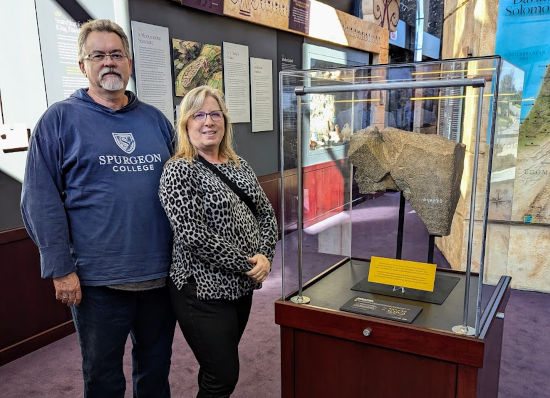
In November 2024, my wife and I stood inches from one of the most significant biblical archaeological discoveries ever made. The Tel Dan Inscription sat behind glass at Armstrong Auditorium in Edmond, Oklahoma, thousands of miles from its ancient home. We stared at broken basalt fragments covered in Aramaic script, and I felt the weight of what we were seeing. This wasn’t a replica or a photograph, this was the real thing.
This ancient stele contained two words that provided the first undisputed proof that King David was real, not legend. For decades, skeptics had dismissed David as a mythical figure like King Arthur. But, when archaeologists found these fragments at a dig site in Israel, everything changed.
The Discovery
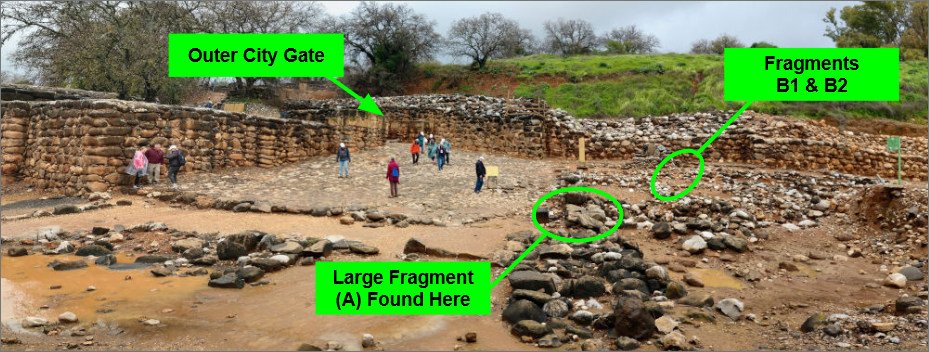
A team found the first fragment in July 1993 at Tel Dan, an archaeological site in northern Israel. They were digging near the site’s ancient city gate when they spotted a piece of stone with writing on it. Archaeologist Avraham Biran and epigrapher Joseph Naveh recognized its significance immediately and published their findings together.1 The team found two more fragments the following year in 1994.2
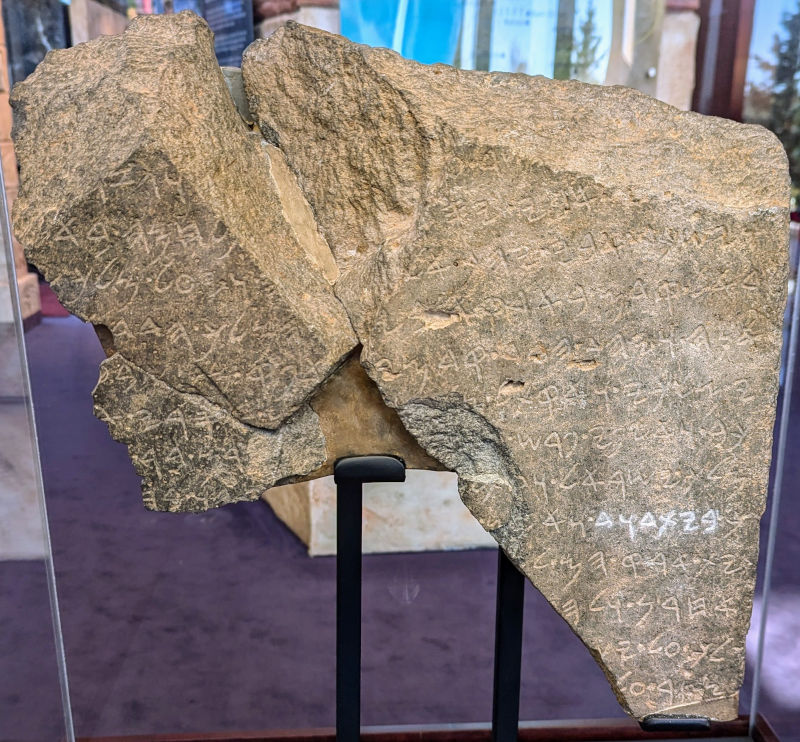
Someone had broken the original stele and reused the pieces as building material centuries ago.
Where is Tel Dan?
Tel Dan sits at the base of Mount Hermon, where one of the Jordan River’s main sources begins. This site witnessed pivotal moments in biblical history. According to Genesis 14, Abraham pursued the kings who had captured his nephew Lot all the way to Dan. Later, after Solomon’s kingdom split in two, King Jeroboam established a rival worship center at Dan (1 Ki 12). He set up a golden calf there (and another at Bethel) to keep northern Israelites from traveling to Jerusalem’s temple.
What is a stele?
A stele (pronounced STEE-lee, STEE-luh, or sometimes STEL-uh) is a stone monument that ancient rulers erected to commemorate victories, record laws, or mark boundaries. Think of it as an ancient billboard carved in stone. Kings wanted everyone to know their accomplishments, so they placed these monuments in public spaces where people would see them.
The fragments surprised researchers because they referenced a biblical dynasty that many scholars had doubted even existed. An earlier discovery, the Mesha Stele (also called the Moabite Stone), found in 1868, also mentions the “House of David.” However, damage to the stone made the reading uncertain and heavily debated. Although recent research has confirmed the Mesha Stele reading,3 the 1993 Tel Dan Inscription changed everything because its text was clear.
The inscription described a military victory by an Aramean king, probably Hazael of Damascus.4 He bragged about defeating the kings of Israel and Judah in battle. But one phrase in that ancient boast changed everything.
The Key Line
Line 9 of the inscription contains two Aramaic words that sent shockwaves through the archaeological community: byt dwd. The words translate as “House of David.”5
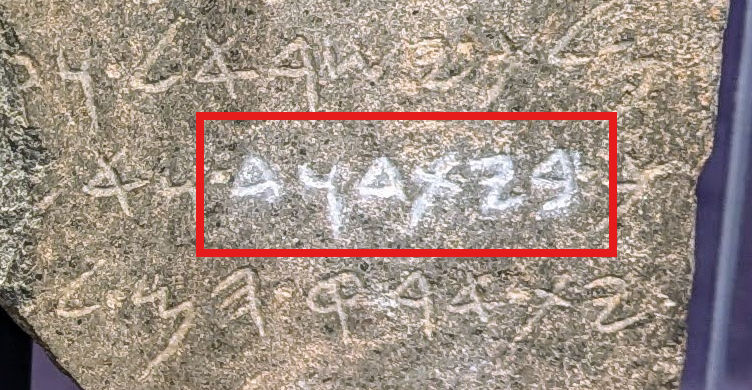
This discovery mattered because minimalist scholars didn’t believe David ever existed as a historical figure. Minimalism in biblical archaeology refers to an approach that treats biblical texts with extreme skepticism. Minimalists argue that most biblical narratives were invented centuries after the events they describe. They consider the biblical histories to be theological literature, not reliable historical sources. Many minimalists had relegated David to the realm of legend, a King Arthur-type figure whose stories inspired later generations.
First Undisputed Inscription
The problem was that there was no undisputed inscription from David’s era or shortly after which mentioned him by name. We had the biblical texts, but critics dismissed those as biased religious documents. Without external confirmation, minimalists argued that David was either entirely fictional or perhaps a minor chieftain whose reputation grew wildly over time.
But the Tel Dan Inscription changed that conversation with one simple phrase. The “House of David” wasn’t a reference to a legendary hero or a mythical founder. The phrase identified a real ruling dynasty that Israel’s enemies recognized and fought against. An Aramean king used this designation to describe the kingdom of Judah and its royal line. He wasn’t recording folklore or repeating religious propaganda, he was documenting a military campaign against an actual political entity.
Why It Matters
For historians, the inscription provided the first undisputed extrabiblical mention of Israel’s most famous king. It confirmed that David wasn’t just a theological construct but a figure significant enough that neighboring kingdoms remembered him. The discovery reminded scholars that absence of evidence isn’t evidence of absence. Just because we haven’t found something doesn’t mean it never existed. The Tel Dan Inscription showed that the biblical text documented real people and events.
Unlike the disputed Moabite Stone, the Tel Dan Inscription’s reading was clear and unambiguous. A few deniers attempted to dispute the translation of the Tel Dan Stele, but their claims lacked credible foundation. The context, grammar, and parallel usage of “House of” constructions for dynasties throughout the ancient Near East all confirmed the reading.
The inscription dates to the second half of the 9th century BC, roughly two centuries after David reigned.6 This timing strengthens the case for David’s historicity. Within two hundred years of his reign, foreign nations referred to Judah’s ruling family as David’s descendants. Nations don’t name dynasties after mythical figures, they name them after real founders whose legitimacy everyone acknowledges. The timing of this reference argues against the theory that David’s reputation developed gradually from folk tales.
A Moment in Edmond
Standing in that Oklahoma exhibition, I thought about the stele’s journey. Aramean workers had carved it over twenty-eight centuries ago. Israelites had smashed it at some point (possibly either king Jehoash, or his son, Jeroboam II).7 8 Ancient builders had recycled the fragments into a wall. Modern archaeologists had pulled those pieces from the ground. Now my wife and I stood staring at words on a stone carved during the time of the kings of Israel and Judah. The inscription reminds us that faith and history intersect in tangible ways.
That November day in Edmond, we saw history written in stone. Two Aramaic words had survived 2800 years as testimony to something important, but something we already knew from the Bible: the shepherd boy who became king was real.
References
- Biran, Avraham, and Joseph Naveh. “An Aramaic Stele Fragment from Tel Dan.” Israel Exploration Journal 43, no. 2/3 (1993): 81–98.
- Biran, Avraham, and Joseph Naveh. “The Tel Dan Inscription: A New Fragment.” Israel Exploration Journal 45, no. 1 (1995): 1–18.
- Langlois, Michaël. “The Tel Dan Inscription After 30 Years: A Fresh Look.” Israel Exploration Journal 74, no. 2 (2024): 59.
- Biran, Avraham, and Joseph Naveh. “The Tel Dan Inscription: A New Fragment.” Israel Exploration Journal 45, no. 1 (1995): 9.
- Biran, Avraham, and Joseph Naveh. “An Aramaic Stele Fragment from Tel Dan.” Israel Exploration Journal 43, no. 2/3 (1993): 90, 93.
- Hagelia, Hallvard. “How Important Is the Tel Dan Stele, Except for Its Relation to the Bible?” Svensk Exegetisk Årsbok 69 (December 2004): 156.
- Biran, Avraham, and Joseph Naveh. “The Tel Dan Inscription: A New Fragment.” Israel Exploration Journal 45, no. 1 (1995): 8.
- 2 Ki 13:25