

Imagine you’re a first-century disciple of Jesus who time-travels to the year 1050 A.D. You attend a local church, but after the assembly ends, you’re bewildered. You’re not even sure you met with fellow disciples. So much has changed—doctrine, structure, and worship—that the church looks almost nothing like the one Jesus started. Over the past 1,000 years, doctrinal drift has made the church of the 11th century nearly unrecognizable.
What began as a grassroots movement of house churches had become two rival institutions: the Roman Catholic Church and the Eastern Orthodox churches. Both had developed layers of ritual, hierarchy, and doctrine unknown to the apostles. While the name “Christianity” remained, many core teachings and practices had shifted. Sometimes radically.
A thousand years of doctrinal drift
Political pressures drove some of these shifts, cultural trends drove others, and the growing institutional power of the church drove still others. But nearly all of them represent clear departures from the simple pattern of belief and practice found in the New Testament. Let’s look back at what changed and why it matters.
From every believer to a religious class
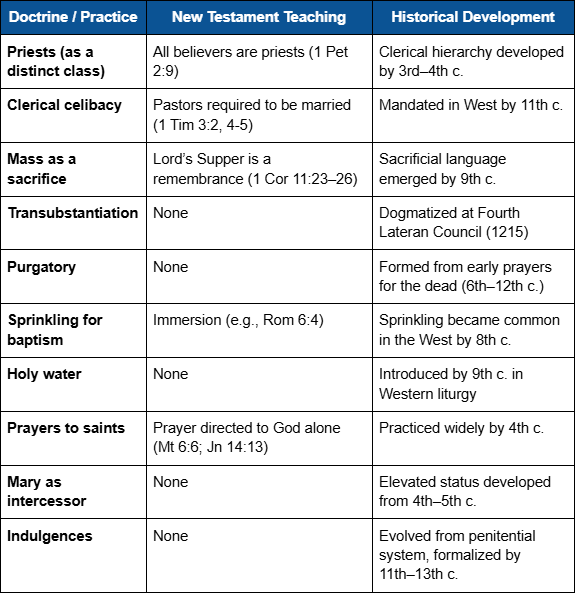
The earliest Christians had no formal clergy. The New Testament describes a church led by shepherds (elders, overseers) who met the practical needs of local congregations (1 Pet 5:1–3; Acts 14:23). There was no special class of priests because all believers were part of a “royal priesthood” (1 Pet 2:9).
But as Christianity spread and organized, a clerical class began to emerge.1 By the third and fourth centuries, bishops gained authority not just over their local church but over entire regions.2 Over time, the clergy–laity divide hardened. What began as practical leadership turned into a sacred office, distinct from the common believer.
Celibacy for priests
In 1 Timothy 3, Paul insists that church leaders be “the husband of one wife,” managing their households well. Early church leaders like Peter took wives. But in the West, this changed dramatically. By the 11th century, celibacy became mandatory for priests.3 The idea was that marriage distracted from holy service.
While some chose to practice celibacy earlier, the church didn’t enforce it across the board until much later and it never had biblical support.4 This change reflected cultural values and a rising belief that celibacy was a higher spiritual state than marriage.
From a meal to a sacrifice
Jesus instituted the Lord’s Supper as a memorial; a way to remember His death until he returns (1 Cor 11:23–26). The early church saw it as a communal meal, shared in homes, with spiritual meaning and joy.
Over time, this simple remembrance morphed into something very different. By the 9th century, the church began using sacrificial language and called it the Mass. It was no longer just about remembering Christ’s sacrifice but about recreating the sacrifice on the church altar.5 This shift changed how people viewed communion; no longer as a fellowship meal, but as a sacred ritual performed by a priest on behalf of the people.
Transubstantiation: Dogma with no biblical anchor
Perhaps the most dramatic doctrinal shift was the teaching of transubstantiation; the idea that the bread and wine of communion become the literal body and blood of Christ. This teaching has no basis in Scripture, and the church didn’t even fully formalize it until the Fourth Lateran Council in 1215.6
Before that, there were differing views on what Christ meant when he said, “This is my body.” But the move to dogmatize transubstantiation marked a major turn. It brought deep reverence, but also deep fear, to the Lord’s Supper, now seen as a mystical event requiring careful handling and a consecrated priest.
The rise of purgatory
The New Testament teaches that after death comes judgment (Heb 9:27), and that salvation is either received or rejected in this life. Yet by the early Middle Ages, a new concept had taken root: purgatory.7 The church viewed this as a temporary place where God purified souls before they entered heaven.
Purgatory developed slowly, beginning with prayers for the dead and growing over centuries into a formal doctrine. It’s not found in Scripture, but by the 12th century, it was widely accepted in the West and used to justify practices like indulgences.
Baptism: From burial to sprinkling
Paul describes baptism as a burial and resurrection (Rom 6:4), and early Christians practiced full immersion. This mode matched the symbolism of dying and rising with Christ.
But immersion gradually gave way to sprinkling, especially in the West. This shift happened partly for convenience or where infant baptism became standard. Eventually, sprinkling became common even though it no longer pictured the biblical meaning of baptism.8
New rituals: Holy water and more
Another innovation was the use of holy water blessed by a priest and believed to ward off evil. The New Testament never mentions this practice, but it entered Western liturgy around the 9th century.
Like many later traditions, holy water blended Christian symbols with older cultural superstitions.9 Over time, it became standard practice in churches and homes, despite its lack of biblical support.
Prayers to saints, and to Mary
Jesus taught his followers to pray directly to the Father (Mt 6:6), and he promised that prayers in his name would be heard (Jn 14:13). Yet by the 4th century, prayers to saints became common. Christians believed these saints, being in heaven, could intercede on their behalf.10
Mary in particular took on an increasingly exalted role. By the 5th century, the church called her “Mother of God” (Theotokos) and later honored her as the chief intercessor.11 Though born of genuine love and reverence, this practice subtly undermined the unique role of Christ as our only mediator (1 Tim 2:5).
Indulgences: Forgiveness for sale
Perhaps the most infamous departure came with indulgences. In theory, indulgences offered remission of the temporal punishment for sins already forgiven. In practice, they became a way to raise money and manipulate guilt.
Indulgences grew out of the early church’s penitential system.12 The church formalized them between the 11th and 13th centuries. The abuse of indulgences would later spark Martin Luther’s 95 Theses and the Protestant Reformation.
What changed, and what stayed the same
To be clear, not everything about the early church went off course. Belief in Jesus as the risen Son of God remained central. Scribes preserved and copied the Scriptures with care. Many leaders sought truth and holiness. But we cannot ignore the growing distance between the apostolic church and the institutional church that dominated the Middle Ages.
The pattern laid out in the New Testament is clear and simple. The developments we’ve reviewed, however sincere or well-intentioned, added complexity, ritual, and hierarchy not found in the early church. As we prepare to explore the events leading to the Reformation, we need to understand how far things had drifted. Only by looking back can we grasp the need that sparked a cry for renewal: Back to the Bible. Back to Christ.
References
- González, Justo L. . The Story of Christianity: Volume 1: The Early Church to the Dawn of the Reformation (p. 154). HarperCollins. Kindle Edition.
- Schaff, Philip. History of the Christian Church – From The 1st To The 19th Century (All 8 Volumes) (Kindle Locations 39100-39101). www.DelmarvaPublications.com. Kindle Edition.
- González, Justo L. . The Story of Christianity: Volume 1: The Early Church to the Dawn of the Reformation (pp. 312-314). HarperCollins. Kindle Edition.
- Schaff, Philip. History of the Christian Church – From The 1st To The 19th Century (All 8 Volumes) (Kindle Locations 38909-38910). www.DelmarvaPublications.com. Kindle Edition.
- González, Justo L. . The Story of Christianity: Volume 1: The Early Church to the Dawn of the Reformation (p. 288). HarperCollins. Kindle Edition.
- González, Justo L. . The Story of Christianity: Volume 1: The Early Church to the Dawn of the Reformation (p. 321). HarperCollins. Kindle Edition.
- Schaff, Philip. History of the Christian Church – From The 1st To The 19th Century (All 8 Volumes) (Kindle Location 24808). www.DelmarvaPublications.com. Kindle Edition.
- Harrison, Wes. “The Renewal of the Practice of Adult Baptism by Immersion During the Reformation Era, 1525-1700.” Restoration Quarterly 43, no. 2 (2001): 96-97.
- Schaff, Philip. History of the Christian Church – From The 1st To The 19th Century (All 8 Volumes) (Kindle Location 43581). www.DelmarvaPublications.com. Kindle Edition.
- Schaff, Philip. History of the Christian Church – From The 1st To The 19th Century (All 8 Volumes) (Kindle Location 40991). www.DelmarvaPublications.com. Kindle Edition.
- Schaff, Philip. History of the Christian Church – From The 1st To The 19th Century (All 8 Volumes) (Kindle Location 24476). www.DelmarvaPublications.com. Kindle Edition.
- Schaff, Philip. History of the Christian Church – From The 1st To The 19th Century (All 8 Volumes) (Kindle Locations 58649-58650). www.DelmarvaPublications.com. Kindle Edition.