
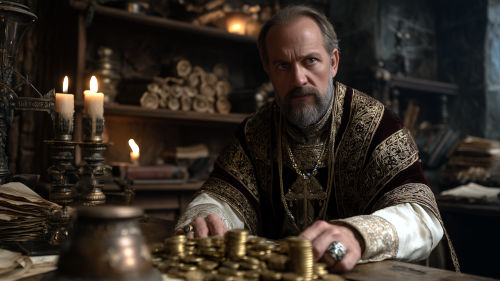
By the late Middle Ages, the Roman Catholic Church was the most powerful institution in Europe. It shaped laws, crowned kings, and claimed authority over the people. But behind its authority and rituals, corruption had taken root. Many ordinary Christians had grown uneasy, knowing that something had gone terribly wrong.
Over time, the Church had gained wealth, land, and influence. With that power came temptation. Leaders began to treat spiritual positions as tools for personal gain. Instead of serving the people and pointing them to Christ, many used the Church to enrich themselves, reward their families, or control politics. Jesus warned about this: “You cannot serve God and money” (Mt 6:24). But by this point, money had clearly taken the lead.
What happened to the Church?
Several patterns of corruption had become disturbingly common.
Selling church positions
One of the most common problems was simony, the practice of buying and selling church roles. The name comes from Simon the Sorcerer, who offered the apostles money so he could receive the power of the Holy Spirit (Acts 8:18–20). Peter rebuked him sharply: “May your silver perish with you, because you thought you could obtain the gift of God with money!” In the same spirit, wealthy families in the Middle Ages paid to have their sons placed as priests or even bishops (leaders over regions of churches).1 God meant these roles for godly men called to shepherd the church (Ti 1:7–9), but people treated them like goods in the marketplace. It was about money and power, not ministry.
Favoring family over faith
Nepotism was another major issue. Church leaders gave important positions to their relatives, regardless of their character or calling. Popes handed out powerful roles to their nephews, cousins, or even secret sons.2 They made these appointments to keep power in the family, not to serve God’s people. As a result, the church became tangled in family politics and lost focus on the gospel.
Clergy who didn’t show up
Many church leaders collected money from more than one church or monastery, even though they could only live in one place at a time. This practice was known as pluralism. Some oversaw several regions but never visited the churches under their care. Others left local priests in charge while they lived in distant cities. These absentee leaders enjoyed the benefits of their offices without doing the work.3 But Jesus modeled the opposite: “I am the good shepherd. The good shepherd lays down his life for the sheep” (Jn 10:11).
Paying for forgiveness
Originally, an indulgence aimed to reduce time in purgatory (a Catholic teaching about a place of purification before heaven) for those who repented and did acts of penance. But over time, indulgences were sold for money. Priests claimed that if you paid enough, you could free a loved one from purgatory, or even secure your own salvation.4 This turned God’s forgiveness into a financial transaction and confused people about the true nature of grace. Forgiveness is a gift of grace, not a product for sale (Eph 2:8–9).
Moral failures of church leaders
The Church required priests and monks to remain celibate, but many ignored the rule. Some kept mistresses or fathered children.5 Monasteries, once devoted to prayer and service, gained reputations for laziness and luxury. But the New Testament never required celibacy for church leaders. In fact, Paul wrote that an overseer “must be the husband of one wife… managing his own household well” (1 Tim 3:2, 4). Rather than encouraging marriage and moral accountability, the Church elevated a rule that many could not or would not keep. The result was hypocrisy, scandal, and broken trust.
Power struggles and political corruption
Secular kings and rulers often influenced who became pope.6 In return, popes acted like political leaders, making deals, declaring wars, and defending their power with armies. This made it hard for people to see the difference between spiritual leadership and political control. James offers a sobering test for such ambition: “Where jealousy and selfish ambition exist, there will be disorder and every vile practice” (Jas 3:16). That describes this era all too well.
A church divided against itself
In the late 1300s, the Church fell into open division. For nearly forty years, there were two, and at one point, three, men claiming to be the true pope!7 Each had his own supporters. This crisis, called the Western Schism, wasn’t about theology, it was about power. The confusion left many wondering who, if anyone, truly spoke for God. It badly damaged the Church’s unity and reputation.
A church dressed like a kingdom
The Church owned massive amounts of land and wealth. Bishops and cardinals wore fine clothing, lived in palaces, and held banquets like nobility. Spiritual offices became high-paying careers rather than humble callings. Many ordinary believers began to ask: Is this what Jesus intended?
The ground was ready for reform
These problems didn’t develop overnight. They grew over centuries. And though some people raised concerns, few had the power, or the courage, to push for real change. But the pressure kept building. By the early 1500s, the Church was like a dry forest in summer. All it needed was a spark.
That spark was coming soon.
References
- González, Justo L. . The Story of Christianity: Volume 1: The Early Church to the Dawn of the Reformation (p. 331). HarperCollins. Kindle Edition.
- González, Justo L. . The Story of Christianity: Volume 1: The Early Church to the Dawn of the Reformation (p. 401). HarperCollins. Kindle Edition.
- González, Justo L. . The Story of Christianity: Volume 1: The Early Church to the Dawn of the Reformation (pp. 409-410). HarperCollins. Kindle Edition.
- González, Justo L. . The Story of Christianity: Volume 1: The Early Church to the Dawn of the Reformation (p. 444). HarperCollins. Kindle Edition.
- González, Justo L. . The Story of Christianity: Volume 1: The Early Church to the Dawn of the Reformation (p. 444). HarperCollins. Kindle Edition.
- González, Justo L. . The Story of Christianity: Volume 1: The Early Church to the Dawn of the Reformation (p. 273). HarperCollins. Kindle Edition.
- González, Justo L. . The Story of Christianity: Volume 1: The Early Church to the Dawn of the Reformation (p. 408). HarperCollins. Kindle Edition.