
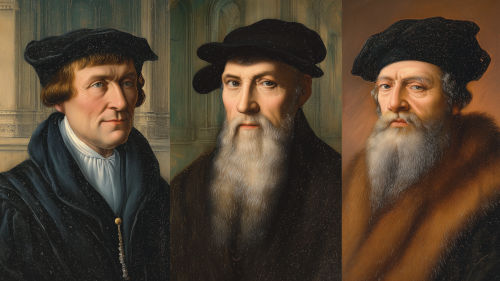
The Reformation began in the early sixteenth century when Martin Luther challenged the authority of the Catholic Church. His Ninety-Five Theses of 1517 protested indulgences and called for a return to Scripture’s authority. Luther’s defiance inspired movements across Europe, but the Reformation quickly developed multiple branches. One of the most influential movements arose in Switzerland, eventually producing Calvinism, the Reformed tradition, and the Presbyterian Church.
Zwingli’s leadership in Zurich
In Switzerland, Ulrich Zwingli emerged as the first major reformer. A priest in Zurich, Zwingli denounced indulgences, clerical corruption, and unscriptural practices. He insisted that Christians must follow the Bible alone, rejecting fasting regulations, veneration of saints, and other Catholic traditions. His reforms were not a result of Luther’s but arose as a parallel movement.1
Zwingli’s boldness inspired followers, but his career ended suddenly. In 1531 he died in battle between Catholic and Protestant forces. His death left the Swiss Reformation leaderless, yet his ideas prepared the way for another reformer who would systematize the movement.
Calvin builds on Zwingli’s work
John Calvin, a French lawyer turned theologian, soon emerged as Zwingli’s successor. Fleeing Catholic persecution in France, he settled in Geneva. There, Calvin established himself as the mastermind of a new order, combining civic discipline with his theological system.
Calvin drew heavily from the writings of Augustine, the 5th century church bishop who emphasized a peculiar view of God’s sovereignty.2 Building on Augustine and Zwingli, Calvin developed a rigorous theology that placed God’s will at the center of salvation and human history. His most famous work, Institutes of the Christian Religion, presented a systematic account of faith that shaped generations of Protestants.
Calvin’s theology
Calvin’s teaching became known as Calvinism, later summarized in the acronym TULIP. These five points provide a concise outline of his views. Sin corrupts every aspect of human nature according to Total Depravity, leaving people incapable of turning to God of their own free will. According to Unconditional Election, God chooses whom He will save without regard to human will. Limited Atonement teaches that Christ’s death was never intended for all people but only for the elect. Irresistible Grace teaches that those whom God has chosen will respond in faith, having no ability to resist God’s call. Perseverance of the saints teaches that those God has chosen will never reject Him or lose their salvation.
This theology placed salvation entirely in God’s hands, leaving mankind with no ability to choose or reject God. Calvin redefined sovereignty to mean that God governs every detail of existence and stands as the ultimate cause of all things, including human sin and history’s darkest atrocities.3 Modern teachers such as John Piper echo this view of sovereignty:
“In other words, it isn’t just that God manages to turn the evil aspects of our world to good for those who love him; it is rather that he himself brings about these evil aspects for his glory. … This includes as incredible and as unacceptable as it may currently seem – God’s having even brought about the Nazis’ brutality at Birkenau and Auschwitz as well as the terrible killings of Dennis Rader and even the sexual abuse of a young child.”4
Geneva under Calvin
Calvin transformed Geneva into what many called the “Protestant Rome.”5 The city became a training ground for reformers from across Europe. Calvin ruled Geneva with iron discipline, blending civic and church authority. He imposed strict moral codes, regulating dress, entertainment, and worship. Society operated under a watchful eye, and disobedience often carried severe penalties.6
Critics and rivals faced banishment, imprisonment, or worse. The most notorious case was Michael Servetus, a Spanish theologian who denied the Trinity. Calvin had written to his colleague William Farel in 1546, stating, “Servetus has just sent me a long volume of his ravings. If I consent he will come here, but I will not give my word, for should he come, if my authority is of any avail, I will not suffer him to get out alive.”7
When Servetus did arrive in Geneva in 1553, the authorities arrested him, tried him, and executed him by burning at the stake. Calvin supported Servetus’s execution, an act that secured his reputation as a ruthless enforcer of orthodoxy. Geneva demonstrated both the strength and the severity of Calvin’s vision.
Knox and the Scottish Reformation
Despite controversy, Geneva attracted exiles who carried Calvin’s ideas back home. Among them was John Knox, a fiery Scottish preacher. Knox studied in Geneva, embraced Calvin’s theology, and returned determined to reform Scotland’s church.8
Knox preached against Catholic practices and rallied support for change. He pushed for a church governed not by bishops but by elders chosen from the people. This presbyterian model reflected Calvin’s emphasis on accountability and shared authority.9 In 1560 the Scottish Parliament officially adopted Protestant reforms, establishing the Church of Scotland as a presbyterian body rooted in Calvinism.10
As Presbyterianism spread, confessional documents gave it stability and clarity. The Westminster Confession of Faith, written in seventeenth-century England, codified Reformed doctrine. This confession remains a cornerstone for many Presbyterian churches today.
From Scotland, Presbyterianism spread widely through migration and missionary activity. Irish, English, and Scottish immigrants carried their faith to North America, where Presbyterians helped shape colonial society. They valued education, discipline, and representative governance, reflecting Calvin’s concern for both order and liberty.
A lasting legacy
The Reformed tradition began with Luther’s spark, grew through Zwingli’s bold preaching, and matured under Calvin’s systematic leadership in Geneva. John Knox then carried Calvin’s legacy into Scotland, where Presbyterianism took firm root and spread worldwide.
Calvin’s influence remains undeniable. He combined Augustine’s theology with Zwingli’s reforms and enforced a vision of relentless discipline and authority. His legacy is complex, marked by brilliance, severity, and a tendency to prioritize control as much as scholarship.
The Presbyterian Church stands today as a living witness to this Reformed heritage. From Geneva’s crucible to global expansion, the Reformed tradition continues to influence Christian life, often carrying with it the weight of rigor and strict oversight over religious thought.
References
- González, Justo L. . The Story of Christianity: Volume 2: The Reformation to the Present Day (p. 60-61). HarperCollins. Kindle Edition.
- González, Justo L. . The Story of Christianity: Volume 2: The Reformation to the Present Day (p. 80). HarperCollins. Kindle Edition.
- Calvin, John. The Institutes of the Christian Religion: The Four Books – Complete and Unabridged. Translated by Thomas Norton. Createspace Independent Publishing Platform, Pantianos Classics, 2017. 1:18:3.
- Piper, John, and Justin Taylor, eds. Suffering and the Sovereignty of God. Wheaton, IL: Crossway Books, 2006. 42
- https://en.wikipedia.org/wiki/Genevan_Reformation
- González, Justo L. . The Story of Christianity: Volume 2: The Reformation to the Present Day (p. 86). HarperCollins. Kindle Edition.
- Hunt, Dave. What Love is This? (p. 93). The Berean Call. Kindle Edition.
- González, Justo L. . The Story of Christianity: Volume 2: The Reformation to the Present Day (p. 101). HarperCollins. Kindle Edition.
- González, Justo L. . The Story of Christianity: Volume 2: The Reformation to the Present Day (p. 103). HarperCollins. Kindle Edition.
- https://en.wikipedia.org/wiki/Church_of_Scotland