
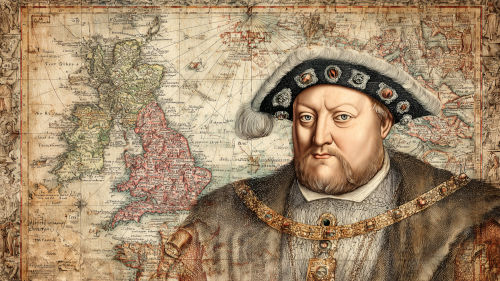
The Protestant Reformation swept across Europe in the early sixteenth century, shaking the foundations of religious and political life. Reformers everywhere insisted that Scripture, not the pope, carried ultimate authority. These ideas created both spiritual opportunities and political crises. England, however, would take its own bold path which was motivated by personal and political ambition. When King Henry VIII couldn’t get his way, he created the Church of England.
A King’s Personal Crisis
When Henry VIII came to the throne in 1509, England was still loyal to Rome. But Henry’s marriage to Catherine of Aragon was in turmoil. Their marriage produced one surviving child, Mary, but no male heir. Henry wanted a son to take the throne after him to ensure his dynasty. Convinced his marriage was cursed, he sought an annulment from the Pope and used the excuse that Catherine’s earlier marriage to his brother made their union invalid.1
Rome Holds Firm
Annulments, which declare that a marriage was never valid in the first place, were a matter of Catholic Church law. As the head of the Catholic Church, the Pope held ultimate authority over these matters.2
In theory, annulments could happen. In practice, Pope Clement VII faced political pressures. Catherine’s nephew, Emperor Charles V, ruled much of Europe and fiercely defended his family’s honor. Granting Henry’s request would offend Charles, weaken alliances, and further erode papal credibility in a period already full of challenges to the Catholic Church. Clement stalled, leaving Henry frustrated and determined to find another way.3
The Break with Rome
By 1534, Henry had run out of patience. With Parliament’s support, he passed the Act of Supremacy, creating the Church of England and declaring himself “Supreme Head” of the new church. This bold move severed England’s ties with Rome and created a church under royal control. Ordinary church goers still saw familiar services, but Henry’s political maneuvering upended the power structures behind them. Most importantly for Henry, breaking with Rome meant he could finally grant his own divorce and marry Anne Boleyn.4
Reformation England
Once Henry had established his own church, the question became how far reform should go. Henry himself kept many Catholic practices and resisted sweeping theological changes. But after his death in 1547, Protestant momentum surged. His young son, Edward VI, inherited the throne, guided by reform-minded advisors eager to align England with Protestant movements across Europe. Services shifted into English, the Book of Common Prayer set new patterns of worship, and preaching from Scripture took center stage. England’s church was now visibly Protestant, though not identical to other emerging Protestant traditions.5
Elizabeth’s Religious Settlement
When Mary I, a devout Catholic, became queen, she tried to undo these changes. She restored papal authority and executed almost three hundred Protestants, earning the nickname “Bloody Mary.” But her reign was short.6
In 1558, Elizabeth I inherited the throne and faced a kingdom weary of extremes. Elizabeth sought stability by blending Protestant belief with traditional forms. The Elizabethan Settlement rejected papal authority and affirmed Protestant doctrine, yet kept bishops, liturgy, and rituals that felt familiar to older generations.
To clarify official belief, Elizabeth later endorsed the Thirty-Nine Articles, a set of statements defining the Church of England’s doctrine, balancing Protestant theology with continuity from the past. This compromise avoided violent religious wars raging across Europe and gave the Church of England its distinctive character.7
An Enduring Legacy
Over time, the Church of England grew into an institution both Protestant and deeply English. It preserved structures like bishops and parish churches while rejecting papal control. The church became not just a religious authority but also a symbol of national identity and independence. As England expanded overseas, missionaries and settlers carried Anglican traditions worldwide, shaping a global communion that still thrives today.
Conclusion
“Henry VIII was essentially conservative on religious matters. He seems to have been a firm believer in most of the traditional teachings of the church, although there is no doubt that his main motivation was political.”8 Regardless, the Church of England’s origin remains inseparable from the Protestant Reformation. Reformers challenged Rome across Europe, while Henry VIII pursued his own mix of political power and personal desire. In the end, his break with Rome reshaped English society, faith, and national life far beyond his private crisis.
References
- González, Justo L. . The Story of Christianity: Volume 2: The Reformation to the Present Day (p. 88). HarperCollins. Kindle Edition.
- González, Justo L. . The Story of Christianity: Volume 2: The Reformation to the Present Day (p. 88). HarperCollins. Kindle Edition.
- González, Justo L. . The Story of Christianity: Volume 2: The Reformation to the Present Day (pp. 88-89). HarperCollins. Kindle Edition.
- González, Justo L. . The Story of Christianity: Volume 2: The Reformation to the Present Day (p. 90). HarperCollins. Kindle Edition.
- González, Justo L. . The Story of Christianity: Volume 2: The Reformation to the Present Day (pp. 93-94). HarperCollins. Kindle Edition.
- González, Justo L. . The Story of Christianity: Volume 2: The Reformation to the Present Day (p. 94). HarperCollins. Kindle Edition.
- González, Justo L. . The Story of Christianity: Volume 2: The Reformation to the Present Day (pp. 97-98). HarperCollins. Kindle Edition.
- González, Justo L. . The Story of Christianity: Volume 2: The Reformation to the Present Day (p. 92). HarperCollins. Kindle Edition.