
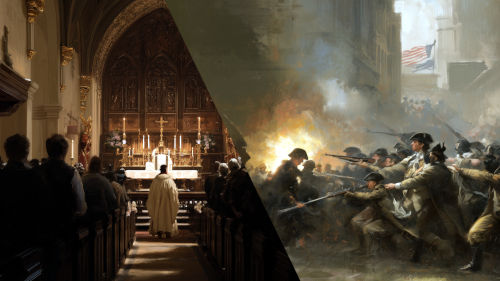
Picture this: It’s 1783. You are an American who just fought in a war to break free from British rule. Your new nation celebrates independence. But every Sunday, you still pray for the King of England in church. Awkward, right?
This was the strange reality facing American Anglicans after the Revolution. They had a problem that went beyond politics. The Church of England wasn’t just their spiritual home. It was legally tied to the British crown. And the king wasn’t just a symbolic figurehead. He was literally the head of their church. Suddenly, this arrangement was no longer feasible.
The Colonial Connection
Anglicanism (i.e., Church of England) had deep roots in the American colonies. It was the established church in many regions, particularly in the South. Virginia planters, New York merchants, and Maryland farmers all had the Anglican tradition in common. They used the Book of Common Prayer, followed the liturgy of the Church of England and took their religious lead from the British Crown.
A major problem was that Anglican clergy took oaths of allegiance to the British monarch.1 Church governance flowed from London. Even the authority to ordain new priests came from English bishops. When the colonies declared independence in 1776, this entire system began to collapse.
American Anglicans faced an identity crisis. They couldn’t exactly keep pledging loyalty to the King. That would be treason. But they also didn’t want to abandon Anglican tradition. Their theology hadn’t changed. Their practices hadn’t changed. Only their political reality had changed.
The Practical Problems
The situation created immediate practical problems. Without bishops loyal to the British crown, who would ordain new clergy? Without connection to England, who would lead the American churches? These were urgent organizational needs.
The solution required creativity and compromise. American Anglicans needed to rebuild their church structure from the ground up. They wanted to preserve what they valued while cutting ties with England. They had to create something both familiar and entirely new.
Birth of the Episcopal Church
In 1789, American Anglicans officially formed the Episcopal Church.2 The name itself signaled continuity and change. “Episcopal” comes from the Greek word for bishop. It emphasized their retained belief in bishops as church leaders. But it dropped any reference to England.
The new church kept the bones of Anglican tradition. They maintained the three-order ministry of bishops, priests, and deacons. American Anglicans continued using the Book of Common Prayer, though adapted for American use. They preserved Anglican liturgy, sacraments, and spiritual practices. The theology stayed essentially the same.
But the governance structure underwent radical change. Out went the monarch as the head of their denomination. In came a democratic structure that reflected American values. The Episcopal Church created a bicameral legislature that looked remarkably like the U.S. Congress.
The House of Bishops included all ordained bishops. The House of Deputies included both clergy and lay representatives from each diocese. Together they formed the General Convention.3 This body made decisions collectively rather than deferring to royal authority.4
At the top sat the Presiding Bishop. This position replaced the monarch’s role but with far less power. The Presiding Bishop leads but doesn’t rule. They coordinate but don’t command. It’s a thoroughly American adaptation of English hierarchy.
Why Not Start Fresh?
You might wonder why American Anglicans bothered with all this reorganization. Why not just join another denomination? American Anglicans loved their tradition. They valued liturgical worship. American Anglicans appreciated the Book of Common Prayer’s language. They believed in episcopal church structure. The Revolution didn’t change any of those convictions. It only changed who could be in charge.
So, they did what Americans do best. They adapted. They kept what worked and discarded what didn’t.
A Revolutionary Compromise
The structure they created in 1789 solved an immediate problem. American Anglicans couldn’t pledge allegiance to a foreign monarch. So they built something that answered to no crown at all.
The allegiance to the British monarch ended. American Anglicans faced a choice between abandoning their tradition or reinventing it. They chose reinvention. The result was a denomination that looked backward and forward simultaneously. The Episcopal Church was born in 1789, solving a political problem while preserving a religious tradition.
References
- Qc, Rupert Bursell. “The Clerical Oath of Allegiance.” Ecclesiastical Law Journal 17, no. 3 (September 2015): 298-299.
- https://www.ebsco.com/research-starters/history/episcopal-church-established.
- https://generalconvention.org/about/.
- Schaff, Philip. History of the Christian Church – From The 1st To The 19th Century (All 8 Volumes) (Kindle Location 113626). www.DelmarvaPublications.com. Kindle Edition.