
By the late medieval period, the Roman Catholic Church had become Europe’s most powerful institution. It crowned kings, shaped laws, and claimed spiritual authority over millions of souls. Yet beneath this impressive facade, serious problems had taken root.
Wealthy families bought church positions, bishops collected salaries from regions they never visited, and priests sold salvation itself. The Church owned vast estates while preaching poverty, and at one point, three different men claimed to be pope simultaneously.
In this environment of spiritual compromise, courageous voices began to rise. Two men stood out as proto-reformers: John Wycliffe in England and John Huss in Bohemia (modern-day Czech Republic). They lived generations before Martin Luther would nail his theses to the Wittenberg door, but they lit fires that would eventually consume medieval Christianity as Europe knew it.
John Wycliffe: The morning star of the Reformation
John Wycliffe earned his reputation as a scholar at Oxford University in the 1300s. Wycliffe made a revolutionary claim that shook medieval Christianity’s foundations. He argued that Scripture, not the Church hierarchy, held ultimate authority in matters of faith.1 The pope could err, councils could make mistakes, but God’s Word remained infallible. This struck at the heart of Catholic teaching, which placed Church tradition and papal authority on equal footing with Scripture.
But Wycliffe didn’t stop with theory. He launched an ambitious translation project, working on an English Bible so ordinary people could read it themselves.2 The Church had kept Scripture locked away in Latin, accessible only to the educated. Church authorities feared that if common people could read the Bible for themselves, they might question priestly interpretations and challenge Church authority. Wycliffe believed every Christian deserved to read God’s Word directly.
His followers, nicknamed “Lollards” (a derogatory term meaning “mumblers”),3 spread his teachings across England. They carried handwritten copies of English Scripture and preached in language that working people could understand. Church authorities hunted them relentlessly, but Wycliffe’s ideas proved harder to kill than the men who carried them.
Wycliffe himself escaped martyrdom, dying of a stroke in 1384. But the Church’s hatred for the reformer outlasted his life. Forty-four years after his death, the Council of Constance declared him a heretic, ordered his body exhumed, and burned. They scattered the ashes in a nearby river.4 Even in death, they refused to let him rest in peace.
John Huss: The Bohemian Reformer
Wycliffe’s writings traveled across Europe and found fertile ground in Bohemia, where a young priest named John Huss began preaching similar ideas. Huss served as dean of the faculty of philosophy at the University of Prague and pastor of Bethlehem Chapel. Both were positions that gave him a platform to challenge Church corruption.
Like Wycliffe, Huss proclaimed that Christ, not the pope, served as head of the Church. He preached that the Bible is the ultimate authority, and disobedient popes should not be obeyed.5 He demanded that the Church return to the simplicity and purity described in the New Testament.
The reformer’s boldest move came when he publicly supported Wycliffe’s writings. Huss refused to back down from his convictions, even when Church authorities demanded his silence.
Huss chose martyrdom
In 1414, Holy Roman Emperor Sigismund promised Huss safe passage to the Council of Constance, where church leaders planned to address the ongoing crisis of authority. But once Huss arrived and refused to recant his teachings, the council imprisoned him. Despite the emperor’s guarantee of safety, they tried him for heresy.
The council offered Huss a choice: renounce his beliefs or face execution. Standing before the most powerful religious authorities in Europe, Huss chose martyrdom. “God is my witness,” he declared, “that I have never taught that of which I have been falsely accused… I appeal to Jesus Christ, the only judge who is almighty and completely just; in his hands I plead my cause, not on the basis of false witnesses and erring councils, but on truth and justice.”6
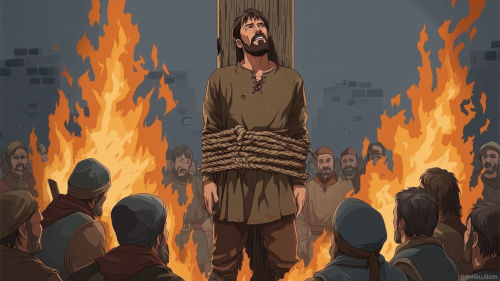
On July 6, 1415, church authorities burned John Huss at the stake. His last words reportedly were: “Lord Jesus, it is for thee that I patiently endure this cruel death. I pray thee to have mercy on my enemies.”7
Seeds of Revolution
The executions of Huss and his follower Jerome of Prague outraged many Christians across Europe. Church leaders had promised safe conduct, then broken their word and murdered men whose only crime was calling for reform. This betrayal convinced many that the institutional Church had moved beyond redemption.
Both Wycliffe and Huss had planted seeds that would germinate in the early 1500s. They proved that people could challenge the Church’s corruption, that ordinary believers could access Scripture directly, and that reform movements could survive even violent persecution.
The Roman Catholic Church had tried to silence these voices, but the questions they raised refused to die: Could the Church reform itself from within? Did Scripture really support the elaborate hierarchy and wealth that characterized medieval Christianity?
By the dawn of the sixteenth century, these questions had created tension across Europe. All it needed was someone bold enough to act on these convictions. That moment was coming soon, and the man who would strike the match was already studying theology in a German monastery, reading the very Scriptures that Wycliffe and Huss had died defending.
References
- González, Justo L. . The Story of Christianity: Volume 1: The Early Church to the Dawn of the Reformation (p. 412). HarperCollins. Kindle Edition.
- González, Justo L. . The Story of Christianity: Volume 1: The Early Church to the Dawn of the Reformation (p. 413). HarperCollins. Kindle Edition.
- https://en.wikipedia.org/wiki/Lollardy#Etymology
- González, Justo L. . The Story of Christianity: Volume 1: The Early Church to the Dawn of the Reformation (p. 415). HarperCollins. Kindle Edition.
- González, Justo L. . The Story of Christianity: Volume 1: The Early Church to the Dawn of the Reformation (p. 418). HarperCollins. Kindle Edition.
- González, Justo L. . The Story of Christianity: Volume 1: The Early Church to the Dawn of the Reformation (p. 419). HarperCollins. Kindle Edition.
- González, Justo L. . The Story of Christianity: Volume 1: The Early Church to the Dawn of the Reformation (p. 419). HarperCollins. Kindle Edition.